A la limite du supportable ! - Exercice 1

1 h
90
Un exercice de détermination des limites.
Question 1
Déterminer les limites suivantes.

lim⁡x ⟶ 01−cos⁡(x)(1−ex)2\lim_{x \, \longrightarrow \, 0} \dfrac{1 - \cos(x)}{(1 - e^x)^2}

Correction
La limite proposée est une forme indéterminée du type 00\dfrac{0}{0}.
La fonction du numérateur x⟼1−cos⁡(x)x \longmapsto 1 - \cos(x) est dérivable, donc continue, sur R\mathbb{R}. Il en est de même pour la fonction du dénominateur x⟼(1−ex)2x \longmapsto (1 - e^x)^2. En outre cette dernière fonction ne s'annule jamais sur R\mathbb{R}. De plus, on a :
∙  (1−cos⁡(x))′=sin⁡(x)   ⟹   (1−cos⁡(x))x=0′=sin⁡(0)=0\bullet \,\, \left( 1-\cos(x) \right)' = \sin(x) \,\,\, \Longrightarrow \,\,\, \left( 1-\cos(x) \right)'_{x=0} = \sin(0) = 0
∙∙  ((1−ex)2)′=−2(1−ex)ex   ⟹   ((1−ex)2)x=0′=−2(1−e0)e0=0\bullet \bullet \,\, \left( (1 - e^x)^2 \right)' = -2(1 - e^x)e^x \,\,\, \Longrightarrow \,\,\, \left( (1 - e^x)^2 \right)'_{x=0} = -2(1 - e^0)e^0 = 0
Donc, la limite lim⁡x ⟶ 0(1−cos⁡(x))′((1−ex)2)′\lim_{x \, \longrightarrow \, 0} \dfrac{\left(1 - \cos(x)\right)'}{\left((1 - e^x)^2\right)'} est encore une forme indéterminée du type 00\dfrac{0}{0}. Nous allons donc réitérer la procédure. On a alors :
∙  (1−cos⁡(x))′′=(sin⁡(x))′=cos⁡(x)   ⟹   (1−cos⁡(x))x=0′′=cos⁡(0)=1\bullet \,\, \left( 1-\cos(x) \right)'' = \left(\sin(x)\right)' = \cos(x) \,\,\, \Longrightarrow \,\,\, \left( 1-\cos(x) \right)''_{x=0} = \cos(0) = 1
∙∙  ((1−ex)2)′′=(−2(1−ex)ex)′=−2(ex−2e2x)   ⟹   ((1−ex)2)−x=0′=−2(e0−2e0)=2≠0\bullet \bullet \,\, \left( (1 - e^x)^2 \right)'' = \left(-2(1 - e^x)e^x\right)' = -2\left(e^x -2e^{2x} \right) \,\,\, \Longrightarrow \,\,\, \left( (1 - e^x)^2 \right)-'_{x=0} = -2\left(e^0 -2e^{0} \right) = 2 \neq 0
La fonction dérivée seconde x⟼−2(ex−2e2x)x \longmapsto -2\left(e^x -2e^{2x} \right) s'annulle vers x=−ln⁡(2)≃−0,7x = - \ln(2)\simeq -0,7, et est donc positive au voisinage très proche de x≃0x \simeq 0 lorsque x ⟶ 0x \, \longrightarrow \, 0.
On en déduit donc que :
lim⁡x ⟶ 0(1−cos⁡(x))′′((1−ex)2)′′=12   ⟹   lim⁡x ⟶ 0(1−cos⁡(x))′((1−ex)2)′=12   ⟹   lim⁡x ⟶ 01−cos⁡(x)(1−ex)2=12\lim_{x \, \longrightarrow \, 0} \dfrac{\left(1 - \cos(x)\right)''}{\left((1 - e^x)^2\right)''} = \dfrac{1}{2} \,\,\, \Longrightarrow \,\,\, \lim_{x \, \longrightarrow \, 0} \dfrac{\left(1 - \cos(x)\right)'}{\left((1 - e^x)^2\right)'} = \dfrac{1}{2} \,\,\, \Longrightarrow \,\,\, \lim_{x \, \longrightarrow \, 0} \dfrac{1 - \cos(x)}{(1 - e^x)^2} = \dfrac{1}{2}
De fait, on peut finalement écrire que :
lim⁡x ⟶ 01−cos⁡(x)(1−ex)2=12{\color{red}{\boxed{\lim_{x \, \longrightarrow \, 0} \dfrac{1 - \cos(x)}{(1 - e^x)^2} = \dfrac{1}{2} }}}
Question 2

lim⁡x ⟶ 0x(cos⁡(x)−1)+tan⁡(x)−sin⁡(x)x2sin⁡(x)+tan⁡(x)−x\lim_{x \, \longrightarrow \, 0} \dfrac{x(\cos(x)-1) + \tan(x) - \sin(x)}{x^2\sin(x) + \tan(x) - x}

Correction
On constate que cette limite se présente sous la forme d'une forme indéterminée du type 00\dfrac{0}{0}.
Puis, sur l'intervalle [−1 ; 1][-1\,;\,1] la fonction se trouvant au numérateur x⟼x(cos⁡(x)−1)+tan⁡(x)−sin⁡(x)x \longmapsto x(\cos(x)-1) + \tan(x) - \sin(x) est dérivable, donc continue, et comme 0∈[−1 ; 1]0 \in [-1\,;\,1] on a :
(x(cos⁡(x)−1)+tan⁡(x)−sin⁡(x))′=1cos⁡2(x)−xsin⁡(x)−1\left(x(\cos(x)-1) + \tan(x) - \sin(x)\right)' = \dfrac{1}{\cos^2(x)}-x\sin(x)-1
Ce qui implique que :
(x(cos⁡(x)−1)+tan⁡(x)−sin⁡(x))x=0′=0\left(x(\cos(x)-1) + \tan(x) - \sin(x)\right)'_{x = 0} = 0
Puis, sur l'intervalle [−1 ; 1][-1\,;\,1], la fonction se trouvant au dénominateur x⟼x2sin⁡(x)+tan⁡(x)−xx \longmapsto x^2\sin(x) + \tan(x) - x est dérivable, donc continue, et comme 0∈[−1 ; 1]0 \in [-1\,;\,1] on a :
(x2sin⁡(x)+tan⁡(x)−x)′=2xsin⁡(x)+x2cos⁡(x)+1cos⁡2(x)−1\left( x^2\sin(x) + \tan(x) - x \right)' = 2x\sin(x) + x^2\cos(x) + \dfrac{1}{\cos^2(x)}-1
Ce qui implique que :
(x2sin⁡(x)+tan⁡(x)−x)x=0′=0\left(x^2\sin(x) + \tan(x) - x\right)'_{x = 0} = 0
Et on constate alors que la limite lim⁡x ⟶ 0(x(cos⁡(x)−1)+tan⁡(x)−sin⁡(x))′(x2sin⁡(x)+tan⁡(x)−x)′\lim_{x \, \longrightarrow \, 0} \dfrac{\left(x(\cos(x)-1) + \tan(x) - \sin(x)\right)'}{\left(x^2\sin(x) + \tan(x) - x\right)'} est également une forme indéterminée du type 00\dfrac{0}{0}. On va donc réitérer la procédure.
Sur l'intervalle [−1 ; 1][-1\,;\,1] la fonction se trouvant au numérateur x⟼x(cos⁡(x)−1)+tan⁡(x)−sin⁡(x)x \longmapsto x(\cos(x)-1) + \tan(x) - \sin(x) est deux fois dérivable, donc continue, et comme 0∈[−1 ; 1]0 \in [-1\,;\,1] on a :
(x(cos⁡(x)−1)+tan⁡(x)−sin⁡(x))′′=2sin⁡(x)cos⁡3(x)−sin⁡(x)−xcos⁡(x)\left(x(\cos(x)-1) + \tan(x) - \sin(x)\right)'' = 2\dfrac{\sin(x)}{\cos^3(x)}-\sin(x)-x\cos(x)
Ce qui implique que :
(x(cos⁡(x)−1)+tan⁡(x)−sin⁡(x))x=0′′=2sin⁡(0)cos⁡3(0)−sin⁡(0)−0cos⁡(0)=0\left(x(\cos(x)-1) + \tan(x) - \sin(x)\right)''_{x = 0} = 2\dfrac{\sin(0)}{\cos^3(0)}-\sin(0)-0\cos(0)= 0
Puis, sur l'intervalle [−1 ; 1][-1\,;\,1], la fonction se trouvant au dénominateur x⟼x2sin⁡(x)+tan⁡(x)−xx \longmapsto x^2\sin(x) + \tan(x) - x est deux fois dérivable, donc continue, et comme 0∈[−1 ; 1]0 \in [-1\,;\,1] on a :
(x2sin⁡(x)+tan⁡(x)−x)′′=2sin⁡(x)+4xcos⁡(x)+2sin⁡(x)cos⁡3(x)−x2sin⁡(x)\left( x^2\sin(x) + \tan(x) - x \right)'' = 2\sin(x) + 4x\cos(x) + 2\dfrac{\sin(x)}{\cos^3(x)}-x^2\sin(x)
Ce qui implique que :
(x2sin⁡(x)+tan⁡(x)−x)x=0′′=0\left(x^2\sin(x) + \tan(x) - x\right)''_{x = 0} = 0
Et on constate alors que la limite lim⁡x ⟶ 0(x(cos⁡(x)−1)+tan⁡(x)−sin⁡(x))′′(x2sin⁡(x)+tan⁡(x)−x)′′\lim_{x \, \longrightarrow \, 0} \dfrac{\left(x(\cos(x)-1) + \tan(x) - \sin(x)\right)''}{\left(x^2\sin(x) + \tan(x) - x\right)''} est à nouveau une forme indéterminée du type 00\dfrac{0}{0}. On va donc réitérer une nouvelle fois la procédure.
Sur l'intervalle [−1 ; 1][-1\,;\,1] la fonction se trouvant au numérateur x⟼x(cos⁡(x)−1)+tan⁡(x)−sin⁡(x)x \longmapsto x(\cos(x)-1) + \tan(x) - \sin(x) est trois fois dérivable, donc continue, et comme 0∈[−1 ; 1]0 \in [-1\,;\,1] on a :
(x(cos⁡(x)−1)+tan⁡(x)−sin⁡(x))′′′=4sin⁡2(x)cos⁡4(x)+xsin⁡(x)+2cos⁡4(x)−2cos⁡(x)\left(x(\cos(x)-1) + \tan(x) - \sin(x)\right)''' = 4\dfrac{\sin^2(x)}{\cos^4(x)}+x\sin(x) + \dfrac{2}{\cos^4(x)} - 2\cos(x)
Ce qui implique que :
(x(cos⁡(x)−1)+tan⁡(x)−sin⁡(x))x=0′′′=4sin⁡2(0)cos⁡4(0)+0sin⁡(0)+2cos⁡4(0)−2cos⁡(0)=2−2=0\left(x(\cos(x)-1) + \tan(x) - \sin(x)\right)'''_{x = 0} = 4\dfrac{\sin^2(0)}{\cos^4(0)}+0\sin(0) + \dfrac{2}{\cos^4(0)} - 2 \cos(0) = 2 - 2 = 0
Puis, sur l'intervalle [−1 ; 1][-1\,;\,1], la fonction se trouvant au dénominateur x⟼x2sin⁡(x)+tan⁡(x)−xx \longmapsto x^2\sin(x) + \tan(x) - x est deux fois dérivable, donc continue, et comme 0∈[−1 ; 1]0 \in [-1\,;\,1] on a :
(x2sin⁡(x)+tan⁡(x)−x)′′′=2cos⁡4(x)−6xsin⁡(x)+4sin⁡2(x)cos⁡4(x)−x2cos⁡(x)+6cos⁡(x)\left( x^2\sin(x) + \tan(x) - x \right)''' = \dfrac{2}{\cos^4(x)} - 6x\sin(x) + 4\dfrac{\sin^2(x)}{\cos^4(x)}-x^2\cos(x) + 6 \cos(x)
Ce qui implique que :
(x2sin⁡(x)+tan⁡(x)−x)x=0′′′=2cos⁡4(0)−6×0sin⁡(0)+4sin⁡2(0)cos⁡4(0)−02cos⁡(0)+6cos⁡(0)=2+6=8≠0\left(x^2\sin(x) + \tan(x) - x\right)'''_{x = 0} = \dfrac{2}{\cos^4(0)} - 6\times 0\sin(0) + 4\dfrac{\sin^2(0)}{\cos^4(0)}-0^2\cos(0) + 6 \cos(0) = 2 + 6 = 8 \neq 0
Et on constate alors que la limite lim⁡x ⟶ 0(x(cos⁡(x)−1)+tan⁡(x)−sin⁡(x))′′′(x2sin⁡(x)+tan⁡(x)−x)′′′\lim_{x \, \longrightarrow \, 0} \dfrac{\left(x(\cos(x)-1) + \tan(x) - \sin(x)\right)'''}{\left(x^2\sin(x) + \tan(x) - x\right)'''} existe bien. Et on a :
lim⁡x ⟶ 0(x(cos⁡(x)−1)+tan⁡(x)−sin⁡(x))′′′(x2sin⁡(x)+tan⁡(x)−x)′′′=08=0\lim_{x \, \longrightarrow \, 0} \dfrac{\left(x(\cos(x)-1) + \tan(x) - \sin(x)\right)'''}{\left(x^2\sin(x) + \tan(x) - x\right)'''} = \dfrac{0}{8} = 0
On en déduit alors que :
lim⁡x ⟶ 0(x(cos⁡(x)−1)+tan⁡(x)−sin⁡(x))′′′(x2sin⁡(x)+tan⁡(x)−x)′′′=0   ⟹   lim⁡x ⟶ 0(x(cos⁡(x)−1)+tan⁡(x)−sin⁡(x))′′(x2sin⁡(x)+tan⁡(x)−x)′′=0\lim_{x \, \longrightarrow \, 0} \dfrac{\left(x(\cos(x)-1) + \tan(x) - \sin(x)\right)'''}{\left(x^2\sin(x) + \tan(x) - x\right)'''} = 0 \,\,\, \Longrightarrow \,\,\, \lim_{x \, \longrightarrow \, 0} \dfrac{\left(x(\cos(x)-1) + \tan(x) - \sin(x)\right)''}{\left(x^2\sin(x) + \tan(x) - x\right)''} = 0
Puis :
lim⁡x ⟶ 0(x(cos⁡(x)−1)+tan⁡(x)−sin⁡(x))′′(x2sin⁡(x)+tan⁡(x)−x)′′=0   ⟹   lim⁡x ⟶ 0(x(cos⁡(x)−1)+tan⁡(x)−sin⁡(x))′(x2sin⁡(x)+tan⁡(x)−x)′=0\lim_{x \, \longrightarrow \, 0} \dfrac{\left(x(\cos(x)-1) + \tan(x) - \sin(x)\right)''}{\left(x^2\sin(x) + \tan(x) - x\right)''} = 0 \,\,\, \Longrightarrow \,\,\, \lim_{x \, \longrightarrow \, 0} \dfrac{\left(x(\cos(x)-1) + \tan(x) - \sin(x)\right)'}{\left(x^2\sin(x) + \tan(x) - x\right)'} = 0
Et donc :
lim⁡x ⟶ 0(x(cos⁡(x)−1)+tan⁡(x)−sin⁡(x))′(x2sin⁡(x)+tan⁡(x)−x)′=0   ⟹   lim⁡x ⟶ 0x(cos⁡(x)−1)+tan⁡(x)−sin⁡(x)x2sin⁡(x)+tan⁡(x)−x=0\lim_{x \, \longrightarrow \, 0} \dfrac{\left(x(\cos(x)-1) + \tan(x) - \sin(x)\right)'}{\left(x^2\sin(x) + \tan(x) - x\right)'} = 0 \,\,\, \Longrightarrow \,\,\, \lim_{x \, \longrightarrow \, 0} \dfrac{x(\cos(x)-1) + \tan(x) - \sin(x)}{x^2\sin(x) + \tan(x) - x} = 0
Finalement :
lim⁡x ⟶ 0x(cos⁡(x)−1)+tan⁡(x)−sin⁡(x)x2sin⁡(x)+tan⁡(x)−x=0{\color{red}{\boxed{ \lim_{x \, \longrightarrow \, 0} \dfrac{x(\cos(x)-1) + \tan(x) - \sin(x)}{x^2\sin(x) + \tan(x) - x} = 0 }}}
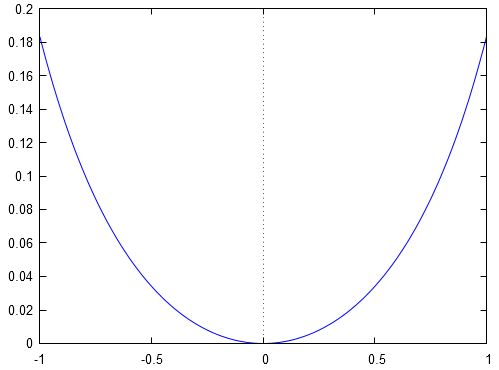
Dans ce cas précis, pour la fonction F:x⟼F(x)=x(cos⁡(x)−1)+tan⁡(x)−sin⁡(x)x2sin⁡(x)+tan⁡(x)−xF : x \longmapsto F(x) =\dfrac{x(\cos(x)-1) + \tan(x) - \sin(x)}{x^2\sin(x) + \tan(x) - x} un prolongement par continuité est possible à l'origine en imposant la condition F(x=0)=0F(x=0) = 0. Graphiquement, sur l'intervalle [−1 ; 1][-1\,;\,1], on vérifie ceci avec la représentation graphique de FF :

Question 3

lim⁡x ⟶ 0ax−bxx\lim_{x \, \longrightarrow \, 0} \dfrac{a^x - b^x}{x} avec aa et bb qui sont deux nombres réels strictement positifs.

Correction
La fonction x⟼ax−bxx \longmapsto a^x - b^x est dérivable, donc continue sur R\mathbb{R}. Il en est de même pour la fonction identité Id:x⟼Id(x)=x\mathrm{Id} : x \longmapsto \mathrm{Id}(x) = x. Puis, on a :
∙  (ax−bx)′=ln⁡(a)ax−ln⁡(b)bx   ⟹   (ax−bx)x=0′=ln⁡(a)a0−ln⁡(b)bx0=ln⁡(a)−ln⁡(b)=ln⁡(ab)\bullet \,\, \left( a^x - b^x \right)' = \ln(a) a^x - \ln(b) b^x \,\,\, \Longrightarrow \,\,\, \left( a^x - b^x \right)'_{x=0} = \ln(a) a^0 - \ln(b) b^x0 = \ln(a) - \ln(b) = \ln\left(\dfrac{a}{b}\right)
∙∙  (x)′=1   ⟹   (x)x=0′=1\bullet \bullet \,\, \left(x\right)' = 1 \,\,\, \Longrightarrow \,\,\, \left(x\right)'_{x=0} = 1
Donc :
lim⁡x ⟶ 0(ax−bx)′x′=ln⁡(ab)1=ln⁡(ab)   ⟹   lim⁡x ⟶ 0ax−bxx=ln⁡(ab)\lim_{x \, \longrightarrow \, 0} \dfrac{\left(a^x - b^x\right)'}{x'} = \dfrac{\ln\left( \dfrac{a}{b} \right)}{1} = \ln\left( \dfrac{a}{b} \right) \,\,\, \Longrightarrow \,\,\, \lim_{x \, \longrightarrow \, 0} \dfrac{a^x - b^x}{x} = \ln\left( \dfrac{a}{b} \right)
Finalement :
lim⁡x ⟶ 0ax−bxx=ln⁡(ab){\color{red}{\boxed{\lim_{x \, \longrightarrow \, 0} \dfrac{a^x - b^x}{x} = \ln\left( \dfrac{a}{b} \right) }}}
Question 4

lim⁡x ⟶ 0ln⁡(cos⁡(ax))ln⁡(cos⁡(bx))\lim_{x \, \longrightarrow \, 0} \dfrac{\ln\left( \cos(ax) \right)}{\ln\left( \cos(bx) \right)} avec aa et bb qui sont deux nombres réels strictement positifs.

Correction
On constate que cette limite se présente sous la forme d'une forme indéterminée du type 00\dfrac{0}{0}.
Puis, sur l'intervalle ]−π2a ; π2a[\left] - \dfrac{\pi}{2a} \,;\, \dfrac{\pi}{2a} \right[, la fonction se trouvant au numérateur x⟼ln⁡(cos⁡(ax))x \longmapsto \ln\left( \cos(ax) \right) est dérivable, donc continue. Donc, sur l'intervalle ]−π2a ; π2a[\left] - \dfrac{\pi}{2a} \,;\, \dfrac{\pi}{2a} \right[, on a:
(ln⁡(cos⁡(ax)))′=−asin⁡(ax)cos⁡(ax)=−atan⁡(ax)\left(\ln\left( \cos(ax) \right)\right)' = \dfrac{-a\sin(ax)}{\cos(ax)} = - a \tan(ax)
Ce qui implique que :
(ln⁡(cos⁡(ax)))x=0′=−atan⁡(a0)=−a×0=0\left(\ln\left(\cos(ax)\right)\right)'_{x = 0} = - a \tan(a0) = - a \times 0 = 0
De même, sur l'intervalle ]−π2b ; π2b[\left] - \dfrac{\pi}{2b} \,;\, \dfrac{\pi}{2b} \right[, la fonction se trouvant au dénominateur x⟼ln⁡(cos⁡(bx))x \longmapsto \ln\left( \cos(bx) \right) est dérivable, donc continue. Donc, sur l'intervalle ]−π2b ; π2b[\left] - \dfrac{\pi}{2b} \,;\, \dfrac{\pi}{2b} \right[, on a:
(ln⁡(cos⁡(bx)))′=−bsin⁡(bx)cos⁡(bx)=−btan⁡(bx)\left(\ln\left( \cos(bx) \right)\right)' = \dfrac{-b\sin(bx)}{\cos(bx)} = - b \tan(bx)
Ce qui implique que :
(ln⁡(cos⁡(bx)))x=0′=−btan⁡(b0)=−b×0=0\left(\ln\left(\cos(bx)\right)\right)'_{x = 0} = - b \tan(b0) = - b \times 0 = 0
Ainsi, sur l'intervalle ]−π2a ; π2a[∩]−π2b ; π2b[\left] - \dfrac{\pi}{2a} \,;\, \dfrac{\pi}{2a} \right[ \cap \left] - \dfrac{\pi}{2b} \,;\, \dfrac{\pi}{2b} \right[ (et 00 y appartient), la limite lim⁡x ⟶ 0(ln⁡(cos⁡(ax)))′(ln⁡(cos⁡(bx)))′\lim_{x \, \longrightarrow \, 0} \dfrac{\left(\ln\left( \cos(ax) \right)\right)'}{\left(\ln\left( \cos(bx) \right)\right)'} n'est pas définie car toujours du type 00\dfrac{0}{0}. On réitère donc la procédure.
Sur l'intervalle ]−π2a ; π2a[\left] - \dfrac{\pi}{2a} \,;\, \dfrac{\pi}{2a} \right[, la fonction se trouvant au numérateur x⟼ln⁡(cos⁡(ax))x \longmapsto \ln\left( \cos(ax) \right) est deux fois dérivable, donc continue. Donc, sur l'intervalle ]−π2a ; π2a[\left] - \dfrac{\pi}{2a} \,;\, \dfrac{\pi}{2a} \right[, on a :
(ln⁡(cos⁡(ax)))′′=(−atan⁡(ax))′=−a2(1+tan⁡2(ax))\left(\ln\left( \cos(ax) \right)\right)'' = \left( - a \tan(ax) \right)' = -a^2 \left( 1 + \tan^2(ax) \right)
Ce qui implique que :
(ln⁡(cos⁡(ax)))x=0′′=−a2(1+tan⁡2(a0))=−a2(1+0)=−a2\left(\ln\left(\cos(ax)\right)\right)''_{x = 0} = - a^2 \left( 1 + \tan^2(a0) \right) = -a^2 \left( 1 + 0 \right) = - a^2
De même, sur l'intervalle ]−π2b ; π2b[\left] - \dfrac{\pi}{2b} \,;\, \dfrac{\pi}{2b} \right[, la fonction se trouvant au dénominateur x⟼ln⁡(cos⁡(bx))x \longmapsto \ln\left( \cos(bx) \right) est deux fois dérivable, donc continue. Donc, sur l'intervalle ]−π2b ; π2b[\left] - \dfrac{\pi}{2b} \,;\, \dfrac{\pi}{2b} \right[, on a :
(ln⁡(cos⁡(bx)))′′=(−btan⁡(bx))′=−b2(1+tan⁡2(bx))\left(\ln\left( \cos(bx) \right)\right)'' = \left( - b \tan(bx) \right)' = -b^2 \left( 1 + \tan^2(bx) \right)
Ce qui implique que :
(ln⁡(cos⁡(ax)))x=0′′=−b2(1+tan⁡2(a0))=−b2(1+0)=−b2≠0\left(\ln\left(\cos(ax)\right)\right)''_{x = 0} = - b^2 \left( 1 + \tan^2(a0) \right) = -b^2 \left( 1 + 0 \right) = - b^2 \neq 0
Ainsi, sur l'intervalle ]−π2a ; π2a[∩]−π2b ; π2b[\left] - \dfrac{\pi}{2a} \,;\, \dfrac{\pi}{2a} \right[ \cap \left] - \dfrac{\pi}{2b} \,;\, \dfrac{\pi}{2b} \right[ (et 00 y appartient), la limite lim⁡x ⟶ 0(ln⁡(cos⁡(ax)))′′(ln⁡(cos⁡(bx)))′′\lim_{x \, \longrightarrow \, 0} \dfrac{\left(\ln\left( \cos(ax) \right)\right)''}{\left(\ln\left( \cos(bx) \right)\right)''} existe. On a donc :
lim⁡x ⟶ 0(ln⁡(cos⁡(ax)))′′(ln⁡(cos⁡(bx)))′′=−a2−b2=a2b2=(ab)2\lim_{x \, \longrightarrow \, 0} \dfrac{\left(\ln\left( \cos(ax) \right)\right)''}{\left(\ln\left( \cos(bx) \right)\right)''} = \dfrac{-a^2}{-b^2} = \dfrac{a^2}{b^2} = \left(\dfrac{a}{b}\right)^2
On en déduit donc que :
lim⁡x ⟶ 0(ln⁡(cos⁡(ax)))′′(ln⁡(cos⁡(bx)))′′=(ab)2   ⟹   lim⁡x ⟶ 0(ln⁡(cos⁡(ax)))′(ln⁡(cos⁡(bx)))′=(ab)2   ⟹   lim⁡x ⟶ 0ln⁡(cos⁡(ax))ln⁡(cos⁡(bx))=(ab)2\lim_{x \, \longrightarrow \, 0} \dfrac{\left(\ln\left( \cos(ax) \right)\right)''}{\left(\ln\left( \cos(bx) \right)\right)''} = \left(\dfrac{a}{b}\right)^2 \,\,\, \Longrightarrow \,\,\, \lim_{x \, \longrightarrow \, 0} \dfrac{\left(\ln\left( \cos(ax) \right)\right)'}{\left(\ln\left( \cos(bx) \right)\right)'} = \left(\dfrac{a}{b}\right)^2 \,\,\, \Longrightarrow \,\,\, \lim_{x \, \longrightarrow \, 0} \dfrac{\ln\left( \cos(ax) \right)}{\ln\left( \cos(bx) \right)} = \left(\dfrac{a}{b}\right)^2
Finalement :
lim⁡x ⟶ 0ln⁡(cos⁡(ax))ln⁡(cos⁡(bx))=(ab)2{\color{red}{\boxed{\lim_{x \, \longrightarrow \, 0} \dfrac{\ln\left( \cos(ax) \right)}{\ln\left( \cos(bx) \right)} = \left(\dfrac{a}{b}\right)^2 }}}

Signaler une erreur

Aide-nous à améliorer nos contenus en signalant les erreurs ou problèmes que tu penses avoir trouvés.

Connecte-toi ou crée un compte pour signaler une erreur.