Calculs de dérivées et de différentielles : Mise en pratique épisode 7 - Exercice 1

1 h
90
Les fonctions hyperboliques réciproques usuelles sont les suivantes :
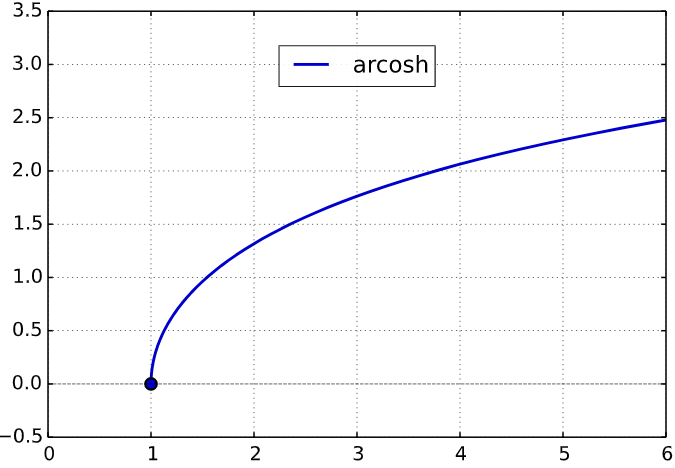
∙   \bullet \,\,\, la fonction argument du cosinus hyperbolique{\color{blue}{\textbf{argument du cosinus hyperbolique}}}, notée argcosh\mathrm{argcosh}, argch\mathrm{argch}, acosh\mathrm{acosh} ou arcosh\mathrm{arcosh}. Puis, on a les propriétés suivantes :
∀x∈ ]1 ; +∞[,  argcosh′(x)=1x2−1\forall x \in \, ]1\,;\, +\infty[, \,\, \mathrm{argcosh}'(x) = \dfrac{1}{\sqrt{x^2-1}}
∀x∈ [1 ; +∞[,  argcosh(x)=ln⁡(x+x2−1)\forall x \in \, [1\,;\, +\infty[, \,\, \mathrm{argcosh}(x) = \ln\left( x + \sqrt{x^2-1} \right)
Cette fonction est non dérivable en x=1x=1 car on il y a l'existence d'une tangente verticale. Son graphe représentatif est la suivant :
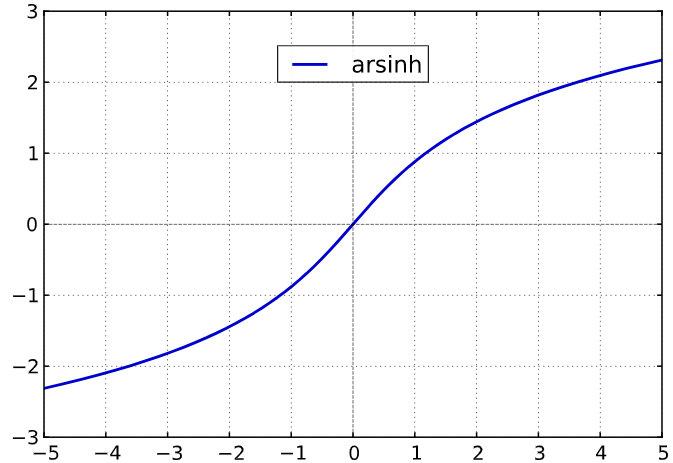
∙∙   \bullet \bullet \,\,\, la fonction argument du sinus hyperbolique{\color{blue}{\textbf{argument du sinus hyperbolique}}}, notée argsinh\mathrm{argsinh}, argsh\mathrm{argsh}, asinh\mathrm{asinh} ou arsinh\mathrm{arsinh}. Puis, on a les propriétés suivantes :
∀x∈ R,  argsinh′(x)=1x2+1\forall x \in \, \mathbb{R}, \,\, \mathrm{argsinh}'(x) = \dfrac{1}{\sqrt{x^2+1}}
∀x∈ R,  argsinh(x)=ln⁡(x+x2+1)\forall x \in \, \mathbb{R}, \,\, \mathrm{argsinh}(x) = \ln\left( x + \sqrt{x^2+1} \right)
Cette fonction est dérivable sur R\mathbb{R}. Son graphe représentatif est la suivant :
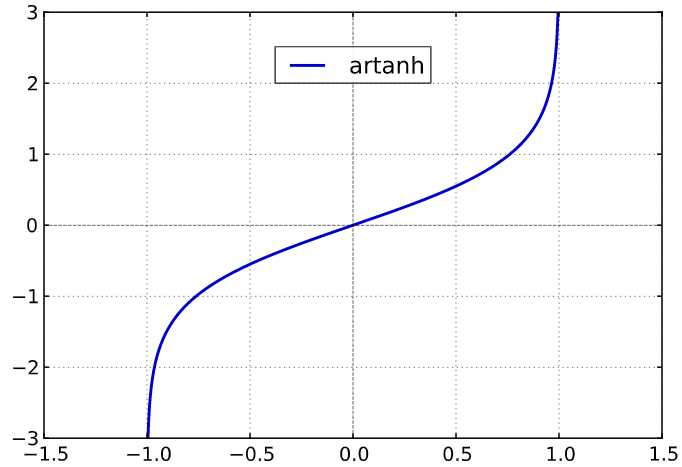
∙∙∙   \bullet \bullet \bullet \,\,\, la fonction argument du tangente hyperbolique{\color{blue}{\textbf{argument du tangente hyperbolique}}}, notée argtanh\mathrm{argtanh}, argth\mathrm{argth}, atanh\mathrm{atanh} ou artanh\mathrm{artanh}. Puis, on a les propriétés suivantes :
∀x∈ ]−1 ; 1[,  argtanh′(x)=11−x2\forall x \in \, ]-1\,;\,1[, \,\, \mathrm{argtanh}'(x) = \dfrac{1}{1-x^2}
∀x∈ [−1 ; 1],  argtanh(x)=12ln⁡(1+x1−x)\forall x \in \, [-1\,;\,1], \,\, \mathrm{argtanh}(x) = \dfrac{1}{2}\ln\left( \dfrac{1+x}{1-x} \right)
Cette fonction n'est pas dérivable en x=±1x=\pm1. Son graphe représentatif est la suivant :
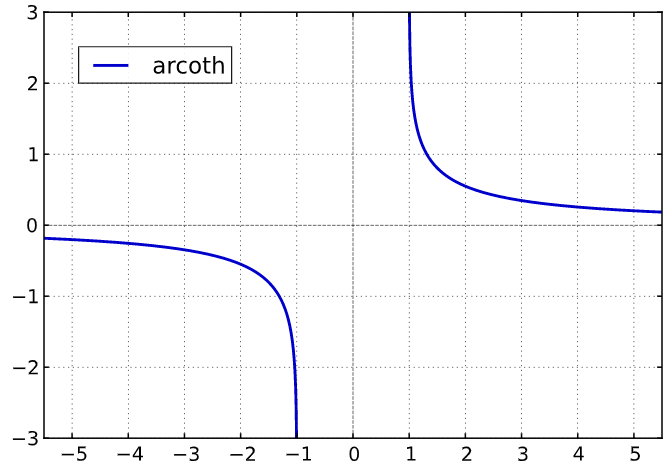
∙∙∙∙   \bullet \bullet \bullet \bullet \,\,\, la fonction argument du cotangente hyperbolique{\color{blue}{\textbf{argument du cotangente hyperbolique}}}, notée argcotanh\mathrm{argcotanh}, argcoth\mathrm{argcoth}, acotanh\mathrm{acotanh} ou arcoth\mathrm{arcoth}. Puis, on a les propriétés suivantes :
∀x∈ ]−∞ ; −1[ ∪ ]1 ; +∞[,  argcotanh′(x)=11−x2\forall x \in \, ]-\infty\,;\,-1[\, \cup \, ]1\,;\,+\infty[ , \,\, \mathrm{argcotanh}'(x) = \dfrac{1}{1-x^2}
∀x∈ ]−∞ ; −1[ ∪ ]1 ; +∞[,  argcotanh(x)=12ln⁡(x+1x−1)\forall x \in \, ]-\infty\,;\,-1[\, \cup \, ]1\,;\,+\infty[, \,\, \mathrm{argcotanh}(x) = \dfrac{1}{2}\ln\left( \dfrac{x+1}{x-1} \right)
Cette fonction n'est pas dérivable en x=±1x=\pm1. Son graphe représentatif est la suivant :
On remarquera également que :
∀x∈ ]−∞ ; −1[ ∪ ]1 ; +∞[,  argcotanh(x)=argtanh(1x)\forall x \in \, ]-\infty\,;\,-1[\, \cup \, ]1\,;\,+\infty[, \,\, \mathrm{argcotanh}(x) = \mathrm{argtanh}\left(\dfrac{1}{x}\right)
Pour chacune des fonctions suivantes, déterminer la fonction dérivée f′f' et la différentielle associée dfdf.
Question 1

Soit x∈[5 ; 7]⟼f(x)=argcosh(xcos⁡(x))x \in [5\,;\,7] \longmapsto f(x) = \mathrm{argcosh}\left(\dfrac{x}{\cos(x)}\right)

Correction
On a :
f′(x)=(argcosh(xcos⁡(x)))′=(xcos⁡(x))′×1(xcos⁡(x))2−1f'(x) = \left(\mathrm{argcosh}\left(\dfrac{x}{\cos(x)}\right)\right)' = \left(\dfrac{x}{\cos(x)}\right)'\times \dfrac{1}{\sqrt{\left(\dfrac{x}{\cos(x)}\right)^2-1}}
Soit :
f′(x)=(x′cos⁡(x)−xcos⁡′(x)cos⁡2(x))×1x2cos⁡2(x)−cos⁡2(x)cos⁡2(x)f'(x) = \left(\dfrac{x'\cos(x) - x\cos'(x)}{\cos^2(x)}\right)\times \dfrac{1}{\sqrt{\dfrac{x^2}{\cos^2(x)}-\dfrac{\cos^2(x)}{\cos^2(x)}}}
Soit encore :
f′(x)=(cos⁡(x)+xsin⁡(x)cos⁡2(x))×1x2−cos⁡2(x)cos⁡2(x)f'(x) = \left(\dfrac{\cos(x) + x\sin(x)}{\cos^2(x)}\right)\times \dfrac{1}{\sqrt{\dfrac{x^2-\cos^2(x)}{\cos^2(x)}}}
Ce qui s'écrit aussi :
f′(x)=(cos⁡(x)+xsin⁡(x)cos⁡2(x))×∣cos⁡(x)∣x2−cos⁡2(x)f'(x) = \left(\dfrac{\cos(x) + x\sin(x)}{\cos^2(x)}\right)\times \dfrac{|\cos(x)|}{\sqrt{x^2-\cos^2(x)}}
Or, ∀x∈[5 ; 7],cos⁡(x)>0\forall x \in [5\,;\,7], \cos(x)>0, donc ∣cos⁡(x)∣=cos⁡(x)|\cos(x)| = \cos(x). On a alors :
f′(x)=(cos⁡(x)+xsin⁡(x)cos⁡2(x))×cos⁡(x)x2−cos⁡2(x)=(cos⁡(x)+xsin⁡(x)cos⁡(x))×1x2−cos⁡2(x)f'(x) = \left(\dfrac{\cos(x) + x\sin(x)}{\cos^2(x)}\right)\times \dfrac{\cos(x)}{\sqrt{x^2-\cos^2(x)}} = \left(\dfrac{\cos(x) + x\sin(x)}{\cos(x)}\right)\times \dfrac{1}{\sqrt{x^2-\cos^2(x)}}
Ainsi :
f′(x)=(cos⁡(x)cos⁡(x)+xsin⁡(x)cos⁡(x))×1x2−cos⁡2(x)f'(x) = \left(\dfrac{\cos(x) }{\cos(x)} + x\dfrac{\sin(x)}{\cos(x)}\right)\times \dfrac{1}{\sqrt{x^2-\cos^2(x)}}
A savoir :
f′(x)=(1+xtan⁡(x))×1x2−cos⁡2(x)f'(x) = \left(1 + x\tan(x)\right)\times \dfrac{1}{\sqrt{x^2-\cos^2(x)}}
Finalement :
f′(x)=1+xtan⁡(x)x2−cos⁡2(x){\color{red}{\boxed{f'(x) = \dfrac{1 + x\tan(x)}{\sqrt{x^2-\cos^2(x)}} }}}
On a alors :
f′(x)=dfdx(x)f'(x) = \dfrac{df}{dx}(x)
En faisant usage de l'écriture de LeibnizLeibniz, on peut donc écrire que :
df(x)=f′(x) dxdf(x) = f'(x) \, dx
Ainsi, la différentielle de ff est donnée par l'expression suivante :
df(x)=1+xtan⁡(x)x2−cos⁡2(x) dx{\color{red}{\boxed{df(x) = \dfrac{1 + x\tan(x)}{\sqrt{x^2-\cos^2(x)}} \, dx}}}
Question 2

Soit x∈R⋆+⟼f(x)=argsinh(x2sinh⁡(x))x \in \mathbb{R}^{\star+} \longmapsto f(x) = \mathrm{argsinh}\left(\dfrac{x^2}{\sinh(x)}\right)

Correction
On a :
f′(x)=(argsinh(x2sinh⁡(x)))′=(x2sinh⁡(x))′×1(x2sinh⁡(x))2+1f'(x) = \left( \mathrm{argsinh}\left(\dfrac{x^2}{\sinh(x)}\right) \right)' = \left(\dfrac{x^2}{\sinh(x)}\right)' \times \dfrac{1}{\sqrt{\left(\dfrac{x^2}{\sinh(x)}\right)^2+1}}
Soit :
f′(x)=((x2)′sinh⁡(x)−x2sinh⁡′(x)sinh⁡2(x))×1x4sinh⁡2(x)+sinh⁡2(x)sinh⁡2(x)f'(x) = \left(\dfrac{\left(x^2\right)'\sinh(x) - x^2\sinh'(x)}{\sinh^2(x)}\right) \times \dfrac{1}{\sqrt{\dfrac{x^4}{\sinh^2(x)}+\dfrac{\sinh^2(x)}{\sinh^2(x)}}}
Soit encore :
f′(x)=(2xsinh⁡(x)−x2cosh⁡(x)sinh⁡2(x))×1x4+sinh⁡2(x)sinh⁡2(x)f'(x) = \left(\dfrac{2x\sinh(x) - x^2\cosh(x)}{\sinh^2(x)}\right) \times \dfrac{1}{\sqrt{\dfrac{x^4+\sinh^2(x)}{\sinh^2(x)}}}
Ce qui nous donne :
f′(x)=(2xsinh⁡(x)−x2cosh⁡(x)sinh⁡2(x))×∣sinh⁡(x)∣x4+sinh⁡2(x)f'(x) = \left(\dfrac{2x\sinh(x) - x^2\cosh(x)}{\sinh^2(x)}\right) \times \dfrac{|\sinh(x)|}{\sqrt{x^4+\sinh^2(x)}}
Cependant, ∀x∈R⋆+,  sinh⁡(x)>0\forall x \in \mathbb{R}^{\star+}, \,\ \sinh(x) >0, ce qui implique que ∣sinh⁡(x)∣=sinh⁡(x)|\sinh(x)| = \sinh(x). Donc :
f′(x)=(2xsinh⁡(x)−x2cosh⁡(x)sinh⁡2(x))×sinh⁡(x)x4+sinh⁡2(x)f'(x) = \left(\dfrac{2x\sinh(x) - x^2\cosh(x)}{\sinh^2(x)}\right) \times \dfrac{\sinh(x)}{\sqrt{x^4+\sinh^2(x)}}
En simplifiant :
f′(x)=(2xsinh⁡(x)−x2cosh⁡(x)sinh⁡(x))×1x4+sinh⁡2(x)f'(x) = \left(\dfrac{2x\sinh(x) - x^2\cosh(x)}{\sinh(x)}\right) \times \dfrac{1}{\sqrt{x^4+\sinh^2(x)}}
Soit encore :
f′(x)=x(2sinh⁡(x)sinh⁡(x)−xcosh⁡(x)sinh⁡(x))×1x4+sinh⁡2(x)f'(x) = x\left(2\dfrac{\sinh(x)}{\sinh(x)} - x\dfrac{\cosh(x)}{\sinh(x)}\right) \times \dfrac{1}{\sqrt{x^4+\sinh^2(x)}}
On obtient alors :
f′(x)=x(2−x cotanh(x))×1x4+sinh⁡2(x)f'(x) = x\left(2 - x \, \mathrm{cotanh}(x)\right) \times \dfrac{1}{\sqrt{x^4+\sinh^2(x)}}
Finalement :
f′(x)=x(2−x cotanh(x))x4+sinh⁡2(x){\color{red}{\boxed{f'(x) = \dfrac{x\left(2 - x \, \mathrm{cotanh}(x)\right)}{\sqrt{x^4+\sinh^2(x)}} }}}
On a alors :
f′(x)=dfdx(x)f'(x) = \dfrac{df}{dx}(x)
En faisant usage de l'écriture de LeibnizLeibniz, on peut donc écrire que :
df(x)=f′(x) dxdf(x) = f'(x) \, dx
Ainsi, la différentielle de ff est donnée par l'expression suivante :
df(x)=x(2−x cotanh(x))x4+sinh⁡2(x) dx{\color{red}{\boxed{df(x) = \dfrac{x\left(2 - x \, \mathrm{cotanh}(x)\right)}{\sqrt{x^4+\sinh^2(x)}} \, dx}}}
Question 3

Soit x∈R+⟼f(x)=argtanh(x2e−3x)x \in \mathbb{R}^{+} \longmapsto f(x) = \mathrm{argtanh}\left(x^2 e^{-3x}\right)

Correction
On a :
f′(x)=(argtanh(x2e−3x))′=(x2e−3x)′×11−(x2e−3x)2f'(x) = \left(\mathrm{argtanh}\left(x^2 e^{-3x}\right) \right)' = \left(x^2 e^{-3x}\right)' \times \dfrac{1}{1-\left(x^2 e^{-3x}\right)^2}
Soit encore :
f′(x)=((x2)′e−3x+x2(e−3x)′)×11−x4e−6xf'(x) = \left(\left(x^2\right)' e^{-3x} + x^2 \left( e^{-3x} \right)'\right) \times \dfrac{1}{1-x^4 e^{-6x}}
Ce qui nous donne :
f′(x)=(2xe−3x−3x2e−3x)×11−x4e−6xf'(x) = \left(2x e^{-3x} - 3x^2 e^{-3x} \right) \times \dfrac{1}{1-x^4 e^{-6x}}
En factorisant, on obtient :
f′(x)=(2−3x)xe−3x×11−x4e−6xf'(x) = \left(2 - 3x \right)x e^{-3x} \times \dfrac{1}{1-x^4 e^{-6x}}
Finalement :
f′(x)=(2−3x)xe−3x1−x4e−6x{\color{red}{\boxed{f'(x) = \dfrac{\left(2 - 3x \right)x e^{-3x}}{1-x^4 e^{-6x}} }}}
On a alors :
f′(x)=dfdx(x)f'(x) = \dfrac{df}{dx}(x)
En faisant usage de l'écriture de LeibnizLeibniz, on peut donc écrire que :
df(x)=f′(x) dxdf(x) = f'(x) \, dx
Ainsi, la différentielle de ff est donnée par l'expression suivante :
df(x)=(2−3x)xe−3x1−x4e−6x dx{\color{red}{\boxed{df(x) = \dfrac{\left(2 - 3x \right)x e^{-3x}}{1-x^4 e^{-6x}} \, dx}}}
Question 4

Soit x∈]π2 ; π[⟼f(x)=argcotanh(xcos⁡2(x))x \in \left]\dfrac{\pi}{2}\,;\,\pi \right[ \longmapsto f(x) = \mathrm{argcotanh}\left(\dfrac{x}{\cos^2(x)}\right)

Correction
On a :
f′(x)=(argcotanh(xcos⁡2(x)))′f'(x) = \left(\mathrm{argcotanh}\left(\dfrac{x}{\cos^2(x)}\right) \right)'
Soit :
f′(x)=(xcos⁡2(x))′×argcotanh′(xcos⁡2(x))f'(x) = \left(\dfrac{x}{\cos^2(x)}\right)' \times \mathrm{argcotanh}'\left(\dfrac{x}{\cos^2(x)}\right)
Soit encore :
f′(x)=(x′cos⁡2(x)−x(cos⁡2(x))′cos⁡4(x))×11−(xcos⁡2(x))2f'(x) = \left(\dfrac{x'\cos^2(x) - x\left(\cos^2(x)\right)'}{\cos^4(x)}\right) \times \dfrac{1}{1-\left(\dfrac{x}{\cos^2(x)}\right)^2}
Ce qui nous donne :
f′(x)=(cos⁡2(x)+2xcos⁡(x)sin⁡(x)cos⁡4(x))×11−x2cos⁡4(x)f'(x) = \left(\dfrac{\cos^2(x) + 2x\cos(x)\sin(x)}{\cos^4(x)}\right) \times \dfrac{1}{1-\dfrac{x^2}{\cos^4(x)}}
Donc :
f′(x)=(cos⁡2(x)+2xcos⁡(x)sin⁡(x)cos⁡4(x))×1cos⁡4(x)cos⁡4(x)−x2cos⁡4(x)f'(x) = \left(\dfrac{\cos^2(x) + 2x\cos(x)\sin(x)}{\cos^4(x)}\right) \times \dfrac{1}{\dfrac{\cos^4(x)}{\cos^4(x)}-\dfrac{x^2}{\cos^4(x)}}
En tenant compte que, pour xx réel, on a 2cos⁡(x)sin⁡(x)=sin⁡(2x)2\cos(x)\sin(x) = \sin(2x), on obtient alors :
f′(x)=(cos⁡2(x)+xsin⁡(2x)cos⁡4(x))×1cos⁡4(x)−x2cos⁡4(x)f'(x) = \left(\dfrac{\cos^2(x) + x\sin(2x)}{\cos^4(x)}\right) \times \dfrac{1}{\dfrac{\cos^4(x) - x^2}{\cos^4(x)}}
De même :
f′(x)=(cos⁡2(x)+xsin⁡(2x)cos⁡4(x))×cos⁡4(x)cos⁡4(x)−x2f'(x) = \left(\dfrac{\cos^2(x) + x\sin(2x)}{\cos^4(x)}\right) \times \dfrac{\cos^4(x)}{\cos^4(x) - x^2}
En simplifiant par cos⁡4(x)≠0\cos^4(x) \neq 0 sur ]π2 ; π[\left]\dfrac{\pi}{2}\,;\,\pi \right[, on trouve que :
f′(x)=(cos⁡2(x)+xsin⁡(2x))×1cos⁡4(x)−x2f'(x) = \left(\cos^2(x) + x\sin(2x)\right) \times \dfrac{1}{\cos^4(x) - x^2}
D'où :
f′(x)=cos⁡2(x)+xsin⁡(2x)cos⁡4(x)−x2f'(x) = \dfrac{\cos^2(x) + x\sin(2x)}{\cos^4(x) - x^2}
Finalement, on trouve que :
f′(x)=cos⁡2(x)+xsin⁡(2x)(cos⁡2(x)+x)(cos⁡2(x)−x){\color{red}{\boxed{f'(x) = \dfrac{\cos^2(x) + x\sin(2x)}{\left(\cos^2(x) + x \right)\left(\cos^2(x) - x \right)} }}}
On a alors :
f′(x)=dfdx(x)f'(x) = \dfrac{df}{dx}(x)
En faisant usage de l'écriture de LeibnizLeibniz, on peut donc écrire que :
df(x)=f′(x) dxdf(x) = f'(x) \, dx
Ainsi, la différentielle de ff est donnée par l'expression suivante :
df(x)=cos⁡2(x)+xsin⁡(2x)(cos⁡2(x)+x)(cos⁡2(x)−x) dx{\color{red}{\boxed{df(x) = \dfrac{\cos^2(x) + x\sin(2x)}{\left(\cos^2(x) + x \right)\left(\cos^2(x) - x \right)} \, dx}}}

Signaler une erreur

Aide-nous à améliorer nos contenus en signalant les erreurs ou problèmes que tu penses avoir trouvés.

Connecte-toi ou crée un compte pour signaler une erreur.