Méthodes comparées - Exercice 1

40 min
65
Le calcul d'une intégrale par deux méthodes différentes.
On note par ff la fonction ff numérique continue suivante :
f:{[−1 ; 1]⟶Rx⟼cos⁡(x)ln⁡(cos⁡(x))f : \left\lbrace \begin{array}{ccc} [-1 \,;\,1] & \longrightarrow & \mathbb{R} \\ & & \\ x & \longmapsto & \cos(x) \ln\left( \cos(x) \right) \\ \end{array} \right.
On note par II l'intégrale suivante :
I=∫0π4f(x) dxI =\int_0^{\frac{\pi}{4}} f(x) \, dx
Question 1

En utilisant une intégration par parties, déterminer la valeur numérique de l'intégrale II.

Correction

On cherche la quantité II suivante :
I=∫0π4f(x) dx=∫0π4cos⁡(x)ln⁡(cos⁡(x)) dxI = \int_0^{\frac{\pi}{4}} f(x) \, dx = \int_0^{\frac{\pi}{4}} \cos(x) \ln\left( \cos(x) \right) \, dx
On va alors primitiver le terme cos⁡(x)\cos(x) pour obtenir sin⁡(x)\sin(x) et dériver ln⁡(cos⁡(x))\ln\left( \cos(x) \right) pour obtenir (cos⁡(x))′cos⁡(x)=−sin⁡(x)cos⁡(x)\dfrac{(\cos(x))'}{\cos(x)} = \dfrac{-\sin(x)}{\cos(x)}. On a alors :
I=[sin⁡(x)×ln⁡(cos⁡(x))]0π4−∫0π4sin⁡(x)×−sin⁡(x)cos⁡(x) dxI = \left[ \sin(x) \times \ln\left( \cos(x) \right) \right]_0^{\frac{\pi}{4}} - \int_0^{\frac{\pi}{4}} \sin(x) \times \dfrac{-\sin(x)}{\cos(x)} \, dx
Soit :
I=[sin⁡(x)ln⁡(cos⁡(x))]0π4+∫0π4sin⁡2(x)cos⁡(x) dxI = \left[ \sin(x) \ln\left( \cos(x) \right) \right]_0^{\frac{\pi}{4}} + \int_0^{\frac{\pi}{4}} \dfrac{\sin^2(x)}{\cos(x)} \, dx
Posons J=∫0π4sin⁡2(x)cos⁡(x) dxJ = \int_0^{\frac{\pi}{4}} \dfrac{\sin^2(x)}{\cos(x)} \, dx. On a alors :
J=∫0π4sin⁡2(x)cos⁡(x) dx=∫0π4sin⁡2(x)cos⁡2(x) cos⁡(x) dx=∫0π4sin⁡2(x)1−sin⁡2(x) cos⁡(x) dxJ = \int_0^{\frac{\pi}{4}} \dfrac{\sin^2(x)}{\cos(x)} \, dx = \int_0^{\frac{\pi}{4}} \dfrac{\sin^2(x)}{\cos^2(x)} \, \cos(x) \, dx = \int_0^{\frac{\pi}{4}} \dfrac{\sin^2(x)}{1- \sin^2(x)} \, \cos(x) \, dx
Posons u=sin⁡(x)u = \sin(x), de fait dudx=ddx(sin⁡(x))=cos⁡(x)\dfrac{du}{dx} = \dfrac{d}{dx} \big( \sin(x) \big) = \cos(x) et donc du= cos⁡(x) dxdu = \, \cos(x) \, dx.
Lorsque x=0x= 0 on en déduit que u=sin⁡(0)=0u = \sin(0) = 0, puis x=π4x= \dfrac{\pi}{4} on en déduit que u=sin⁡(π4)=22u = \sin\left(\dfrac{\pi}{4}\right) = \dfrac{\sqrt{2}}{2}. Ainsi, on obtient :
J=∫022u21−u2 du=∫0221−1+u21−u2 du=∫0221−(1−u2)1−u2 du=∫022(11−u2−1−u21−u2) duJ = \int_0^{\frac{\sqrt{2}}{2}} \dfrac{u^2}{1- u^2} \, du = \int_0^{\frac{\sqrt{2}}{2}} \dfrac{1- 1 + u^2}{1- u^2} \, du = \int_0^{\frac{\sqrt{2}}{2}} \dfrac{1- (1 - u^2)}{1- u^2} \, du = \int_0^{\frac{\sqrt{2}}{2}} \left( \dfrac{1}{1- u^2} - \dfrac{1 - u^2}{1- u^2} \right) \, du
D'où :
J=∫02211−u2 du−∫0221 du=∫0221(1−u)(1+u) du−∫0221 duJ = \int_0^{\frac{\sqrt{2}}{2}} \dfrac{1}{1- u^2} \, du - \int_0^{\frac{\sqrt{2}}{2}} 1 \, du = \int_0^{\frac{\sqrt{2}}{2}} \dfrac{1}{(1- u)(1+u)} \, du - \int_0^{\frac{\sqrt{2}}{2}} 1 \, du
La décomposition en élément simple de 1(1−u)(1+u)\dfrac{1}{(1- u)(1+u)} nous permet d'écrire :
J=∫022(12(u+1)−12(u−1)) du−∫0221 du=12∫0221u+1 du−12∫0221u−1 du−∫0221 duJ = \int_0^{\frac{\sqrt{2}}{2}} \left( \dfrac{1}{2(u+1)} - \dfrac{1}{2(u-1)} \right) \, du - \int_0^{\frac{\sqrt{2}}{2}} 1 \, du = \dfrac{1}{2} \int_0^{\frac{\sqrt{2}}{2}} \dfrac{1}{u+1} \, du - \dfrac{1}{2} \int_0^{\frac{\sqrt{2}}{2}} \dfrac{1}{u-1} \, du - \int_0^{\frac{\sqrt{2}}{2}} 1 \, du
Ce qui nous donne :
J=12[ln⁡(∣u+1∣)]022−12[ln⁡(∣u−1∣)]022−[u]022J = \dfrac{1}{2} \left[ \ln (|u+1|) \right]_0^{\frac{\sqrt{2}}{2}} - \dfrac{1}{2} \left[ \ln (|u-1|) \right]_0^{\frac{\sqrt{2}}{2}} - \left[ u \right]_0^{\frac{\sqrt{2}}{2}}
Donc :
J=12(ln⁡(∣22+1∣)−ln⁡(∣0+1∣))−12(ln⁡(∣22−1∣)−ln⁡(∣0−1∣))−(22−0)J = \dfrac{1}{2} \left( \ln \left( \left| \dfrac{\sqrt{2}}{2} + 1 \right| \right) - \ln \left( \left| 0 + 1 \right| \right) \right) - \dfrac{1}{2} \left( \ln \left( \left| \dfrac{\sqrt{2}}{2} - 1 \right| \right) - \ln \left( \left| 0 - 1 \right| \right) \right) - \left( \dfrac{\sqrt{2}}{2} - 0 \right)
Comme 22+1>0\dfrac{\sqrt{2}}{2} + 1 > 0 et 22−1<0\dfrac{\sqrt{2}}{2} - 1 < 0, on a alors :
J=12(ln⁡(22+1)−ln⁡(∣1∣))−12(ln⁡(1−22)−ln⁡(∣−1∣))−22J = \dfrac{1}{2} \left( \ln \left( \dfrac{\sqrt{2}}{2} + 1 \right) - \ln \left( \left| 1 \right| \right) \right) - \dfrac{1}{2} \left( \ln \left( 1 -\dfrac{\sqrt{2}}{2} \right) - \ln \left( \left| - 1 \right| \right) \right) - \dfrac{\sqrt{2}}{2}
Soit encore :
J=12(ln⁡(2+22)−ln⁡(1))−12(ln⁡(2−22)−ln⁡(1))−22J = \dfrac{1}{2} \left( \ln \left( \dfrac{2+\sqrt{2}}{2} \right) - \ln \left( 1 \right) \right) - \dfrac{1}{2} \left( \ln \left( \dfrac{2-\sqrt{2}}{2} \right) - \ln \left( 1 \right) \right) - \dfrac{\sqrt{2}}{2}
Ce qui nous donne, avec ln⁡(1)=0\ln \left( 1 \right) = 0 :
J=12ln⁡(2+22)−12ln⁡(2−22)−22=12(ln⁡(2+22)−ln⁡(2−22))−22J = \dfrac{1}{2} \ln \left( \dfrac{2+\sqrt{2}}{2} \right) - \dfrac{1}{2} \ln \left( \dfrac{2-\sqrt{2}}{2} \right) - \dfrac{\sqrt{2}}{2} = \dfrac{1}{2} \left( \ln \left( \dfrac{2+\sqrt{2}}{2} \right) - \ln \left( \dfrac{2-\sqrt{2}}{2} \right) \right) - \dfrac{\sqrt{2}}{2}
Soit encore :
J=12ln⁡(2+222−22)−22J = \dfrac{1}{2} \ln \left( \dfrac{\dfrac{2+\sqrt{2}}{2}}{\dfrac{2-\sqrt{2}}{2}} \right) - \dfrac{\sqrt{2}}{2}
D'où :
J=12ln⁡(2+22−2)−22=12ln⁡(2(2+1)2(2−1))−22=12ln⁡(2+12−1)−22J = \dfrac{1}{2} \ln \left( \dfrac{2+\sqrt{2}}{2-\sqrt{2}} \right) - \dfrac{\sqrt{2}}{2} = \dfrac{1}{2} \ln \left( \dfrac{\sqrt{2}(\sqrt{2}+1)}{\sqrt{2}(\sqrt{2}-1)} \right) - \dfrac{\sqrt{2}}{2} = \dfrac{1}{2} \ln \left( \dfrac{\sqrt{2}+1}{\sqrt{2}-1} \right) - \dfrac{\sqrt{2}}{2}
Puis, on a également :
[sin⁡(x)ln⁡(cos⁡(x))]0π4=sin⁡(π4)ln⁡(cos⁡(π4))−sin⁡(0)ln⁡(cos⁡(0))=22ln⁡(22)−0=22ln⁡(12)\left[ \sin(x) \ln\left( \cos(x) \right) \right]_0^{\frac{\pi}{4}} = \sin\left( \dfrac{\pi}{4} \right) \ln\left( \cos \left( \dfrac{\pi}{4} \right) \right) - \sin(0) \ln\left( \cos(0) \right) = \dfrac{\sqrt{2}}{2} \ln\left( \dfrac{\sqrt{2}}{2} \right) - 0 = \dfrac{\sqrt{2}}{2} \ln\left( \dfrac{1}{\sqrt{2}} \right)
D'où :
[sin⁡(x)ln⁡(cos⁡(x))]0π4=−22ln⁡(2)=−22ln⁡(212)=−1222ln⁡(2)=−24ln⁡(2)\left[ \sin(x) \ln\left( \cos(x) \right) \right]_0^{\frac{\pi}{4}} = - \dfrac{\sqrt{2}}{2} \ln\left( \sqrt{2} \right) = - \dfrac{\sqrt{2}}{2} \ln\left( 2^{\frac{1}{2}} \right) = - \dfrac{1}{2}\dfrac{\sqrt{2}}{2} \ln\left( 2 \right) = - \dfrac{\sqrt{2}}{4} \ln\left( 2 \right)
Ainsi, on trouve que :
I=−24ln⁡(2)+12ln⁡(2+12−1)−22=−24ln⁡(2)+12ln⁡(2+12−1)−224I = - \dfrac{\sqrt{2}}{4} \ln\left( 2 \right) + \dfrac{1}{2} \ln \left( \dfrac{\sqrt{2}+1}{\sqrt{2}-1} \right) - \dfrac{\sqrt{2}}{2} = - \dfrac{\sqrt{2}}{4} \ln\left( 2 \right) + \dfrac{1}{2} \ln \left( \dfrac{\sqrt{2}+1}{\sqrt{2}-1} \right) - \dfrac{2\sqrt{2}}{4}
Finalement :
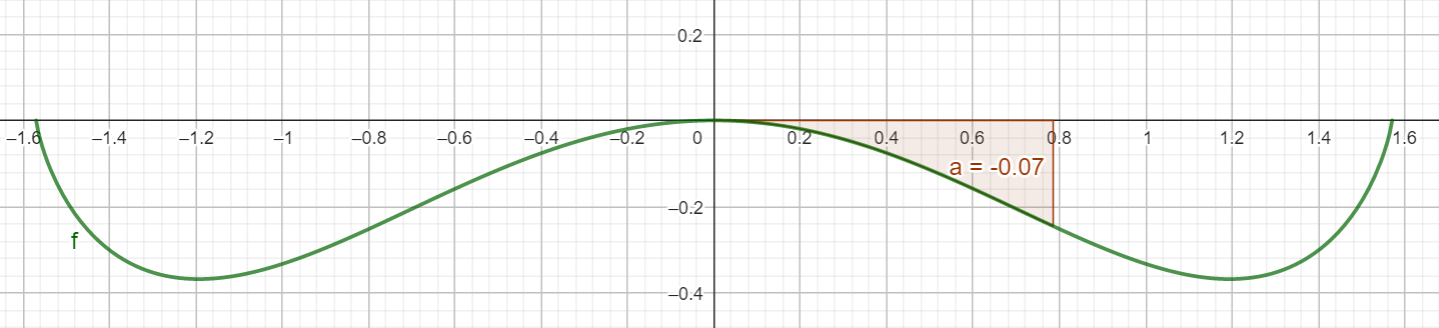
I=−24(2+ln⁡(2))+12ln⁡(2+12−1)  u.a.≃−0,07  u.a.I = - \dfrac{\sqrt{2}}{4} \left( 2 +\ln\left( 2 \right) \right) + \dfrac{1}{2} \ln \left( \dfrac{\sqrt{2}+1}{\sqrt{2}-1} \right) \,\, u.a. \simeq - 0,07 \,\, u.a.
Graphiquement cela correspond à la situation géométrique suivante :
Question 2

En utilisant un changement de variable adéquat, déterminer la valeur numérique de l'intégrale II.

Correction
On cherche à déterminer l'intégrale suivante :
I=∫0π4f(x) dx=∫0π4cos⁡(x)ln⁡(cos⁡(x)) dx=∫0π4ln⁡(cos⁡(x)) cos⁡(x) dxI = \int_0^{\frac{\pi}{4}} f(x) \, dx = \int_0^{\frac{\pi}{4}} \cos(x) \ln\left( \cos(x) \right) \, dx = \int_0^{\frac{\pi}{4}} \ln\left( \cos(x) \right) \, \cos(x) \, dx
La présence du terme cos⁡(x) dx=dsin⁡(x)\cos(x) \, dx = d \sin(x) nous invite à effectuer un changement de variable. Posons alors t=sin⁡(x)t = \sin(x). On a alors cos⁡(x) dx=dt\cos(x) \, dx = d t. Puis, lorsque x=0x = 0 on a t=sin⁡(0)=0t = \sin(0) = 0, et lorsque x=π4x = \dfrac{\pi}{4} on a t=sin⁡(π4)=22t = \sin\left(\dfrac{\pi}{4}\right) = \dfrac{\sqrt{2}}{2}. Enfin, on a également :
cos⁡(x)=cos⁡2(x)=1−sin⁡2(x)=(1−sin⁡2(x))12=(1−t2)12\cos(x) = \sqrt{\cos^2(x)} = \sqrt{1-\sin^2(x)} = \big( 1-\sin^2(x) \big)^{\frac{1}{2}} = \big( 1-t^2 \big)^{\frac{1}{2}}
Donc :
ln⁡(cos⁡(x))=ln⁡((1−t2)12)=12ln⁡(1−t2)\ln\left( \cos(x) \right) = \ln\left( \big( 1-t^2 \big)^{\frac{1}{2}} \right) = \dfrac{1}{2} \ln\left( 1-t^2 \right)
On a alors :
I=∫0π4f(x) dx=∫02212ln⁡(1−t2) dt=∫022(1×12ln⁡(1−t2)) dtI = \int_0^{\frac{\pi}{4}} f(x) \, dx = \int_0^{\frac{\sqrt{2}}{2}} \dfrac{1}{2} \ln\left( 1-t^2 \right) \, dt = \int_0^{\frac{\sqrt{2}}{2}} \left( 1 \times \dfrac{1}{2} \ln\left( 1-t^2 \right) \right) \, dt
Selon la forme indiquée, une intégration par parties semble une méthode appropriée. In va alors primitiver 11 en tt et dériver l'expression 12ln⁡(1−t2)\dfrac{1}{2} \ln\left( 1-t^2 \right) en 12(1−t2)′1−t2=12−2t1−t2=−t1−t2\dfrac{1}{2} \dfrac{\left( 1-t^2 \right)'}{1-t^2} = \dfrac{1}{2} \dfrac{-2t}{1-t^2} = \dfrac{-t}{1-t^2}. Ainsi, on obtient :
I=[t×12ln⁡(1−t2)]022−∫022(t×−t1−t2) dt=[t2ln⁡(1−t2)]022+∫022t21−t2 dtI = \left[ t \times \dfrac{1}{2} \ln\left( 1-t^2 \right) \right]_0^{\frac{\sqrt{2}}{2}} - \int_0^{\frac{\sqrt{2}}{2}} \left( t \times \dfrac{-t}{1-t^2} \right) \, dt = \left[ \dfrac{t}{2} \ln\left( 1-t^2 \right) \right]_0^{\frac{\sqrt{2}}{2}} + \int_0^{\frac{\sqrt{2}}{2}} \dfrac{t^2}{1-t^2} \, dt
Avec :
[t2ln⁡(1−t2)]022=24ln⁡(1−(22)2)=24ln⁡(1−24)=24ln⁡(1−12)=24ln⁡(12)\left[ \dfrac{t}{2} \ln\left( 1-t^2 \right) \right]_0^{\frac{\sqrt{2}}{2}} = \frac{\sqrt{2}}{4}\ln\left( 1-\left( \dfrac{\sqrt{2}}{2} \right)^2 \right) = \frac{\sqrt{2}}{4}\ln\left( 1 - \dfrac{2}{4} \right) = \frac{\sqrt{2}}{4}\ln\left( 1 - \dfrac{1}{2} \right) = \frac{\sqrt{2}}{4}\ln\left( \dfrac{1}{2} \right)
Soit :
[t2ln⁡(1−t2)]022=−24ln⁡(2)\left[ \dfrac{t}{2} \ln\left( 1-t^2 \right) \right]_0^{\frac{\sqrt{2}}{2}} = -\dfrac{\sqrt{2}}{4}\ln\left( 2\right)
Puis, on a (en reprennant la question précédente) :
∫022t21−t2 dt=∫022u21−u2 du=J\int_0^{\frac{\sqrt{2}}{2}} \dfrac{t^2}{1- t^2} \, dt = \int_0^{\frac{\sqrt{2}}{2}} \dfrac{u^2}{1- u^2} \, du = J
Ce qui nous donne :
J=∫022u21−u2 du=∫0221−1+u21−u2 du=∫0221−(1−u2)1−u2 du=∫022(11−u2−1−u21−u2) duJ = \int_0^{\frac{\sqrt{2}}{2}} \dfrac{u^2}{1- u^2} \, du = \int_0^{\frac{\sqrt{2}}{2}} \dfrac{1- 1 + u^2}{1- u^2} \, du = \int_0^{\frac{\sqrt{2}}{2}} \dfrac{1- (1 - u^2)}{1- u^2} \, du = \int_0^{\frac{\sqrt{2}}{2}} \left( \dfrac{1}{1- u^2} - \dfrac{1 - u^2}{1- u^2} \right) \, du
D'où :
J=∫02211−u2 du−∫0221 du=∫0221(1−u)(1+u) du−∫0221 duJ = \int_0^{\frac{\sqrt{2}}{2}} \dfrac{1}{1- u^2} \, du - \int_0^{\frac{\sqrt{2}}{2}} 1 \, du = \int_0^{\frac{\sqrt{2}}{2}} \dfrac{1}{(1- u)(1+u)} \, du - \int_0^{\frac{\sqrt{2}}{2}} 1 \, du
La décomposition en élément simple de 1(1−u)(1+u)\dfrac{1}{(1- u)(1+u)} nous permet d'écrire :
J=∫022(12(u+1)−12(u−1)) du−∫0221 du=12∫0221u+1 du−12∫0221u−1 du−∫0221 duJ = \int_0^{\frac{\sqrt{2}}{2}} \left( \dfrac{1}{2(u+1)} - \dfrac{1}{2(u-1)} \right) \, du - \int_0^{\frac{\sqrt{2}}{2}} 1 \, du = \dfrac{1}{2} \int_0^{\frac{\sqrt{2}}{2}} \dfrac{1}{u+1} \, du - \dfrac{1}{2} \int_0^{\frac{\sqrt{2}}{2}} \dfrac{1}{u-1} \, du - \int_0^{\frac{\sqrt{2}}{2}} 1 \, du
Ce qui nous donne :
J=12[ln⁡(∣u+1∣)]022−12[ln⁡(∣u−1∣)]022−[u]022J = \dfrac{1}{2} \left[ \ln (|u+1|) \right]_0^{\frac{\sqrt{2}}{2}} - \dfrac{1}{2} \left[ \ln (|u-1|) \right]_0^{\frac{\sqrt{2}}{2}} - \left[ u \right]_0^{\frac{\sqrt{2}}{2}}
Donc :
J=12(ln⁡(∣22+1∣)−ln⁡(∣0+1∣))−12(ln⁡(∣22−1∣)−ln⁡(∣0−1∣))−(22−0)J = \dfrac{1}{2} \left( \ln \left( \left| \dfrac{\sqrt{2}}{2} + 1 \right| \right) - \ln \left( \left| 0 + 1 \right| \right) \right) - \dfrac{1}{2} \left( \ln \left( \left| \dfrac{\sqrt{2}}{2} - 1 \right| \right) - \ln \left( \left| 0 - 1 \right| \right) \right) - \left( \dfrac{\sqrt{2}}{2} - 0 \right)
Comme 22+1>0\dfrac{\sqrt{2}}{2} + 1 > 0 et 22−1<0\dfrac{\sqrt{2}}{2} - 1 < 0, on a alors :
J=12(ln⁡(22+1)−ln⁡(∣1∣))−12(ln⁡(1−22)−ln⁡(∣−1∣))−22J = \dfrac{1}{2} \left( \ln \left( \dfrac{\sqrt{2}}{2} + 1 \right) - \ln \left( \left| 1 \right| \right) \right) - \dfrac{1}{2} \left( \ln \left( 1 -\dfrac{\sqrt{2}}{2} \right) - \ln \left( \left| - 1 \right| \right) \right) - \dfrac{\sqrt{2}}{2}
Soit encore :
J=12(ln⁡(2+22)−ln⁡(1))−12(ln⁡(2−22)−ln⁡(1))−22J = \dfrac{1}{2} \left( \ln \left( \dfrac{2+\sqrt{2}}{2} \right) - \ln \left( 1 \right) \right) - \dfrac{1}{2} \left( \ln \left( \dfrac{2-\sqrt{2}}{2} \right) - \ln \left( 1 \right) \right) - \dfrac{\sqrt{2}}{2}
Ce qui nous donne, avec ln⁡(1)=0\ln \left( 1 \right) = 0 :
J=12ln⁡(2+22)−12ln⁡(2−22)−22=12(ln⁡(2+22)−ln⁡(2−22))−22J = \dfrac{1}{2} \ln \left( \dfrac{2+\sqrt{2}}{2} \right) - \dfrac{1}{2} \ln \left( \dfrac{2-\sqrt{2}}{2} \right) - \dfrac{\sqrt{2}}{2} = \dfrac{1}{2} \left( \ln \left( \dfrac{2+\sqrt{2}}{2} \right) - \ln \left( \dfrac{2-\sqrt{2}}{2} \right) \right) - \dfrac{\sqrt{2}}{2}
Soit encore :
J=12ln⁡(2+222−22)−22J = \dfrac{1}{2} \ln \left( \dfrac{\dfrac{2+\sqrt{2}}{2}}{\dfrac{2-\sqrt{2}}{2}} \right) - \dfrac{\sqrt{2}}{2}
D'où :
J=12ln⁡(2+22−2)−22=12ln⁡(2(2+1)2(2−1))−22=12ln⁡(2+12−1)−22J = \dfrac{1}{2} \ln \left( \dfrac{2+\sqrt{2}}{2-\sqrt{2}} \right) - \dfrac{\sqrt{2}}{2} = \dfrac{1}{2} \ln \left( \dfrac{\sqrt{2}(\sqrt{2}+1)}{\sqrt{2}(\sqrt{2}-1)} \right) - \dfrac{\sqrt{2}}{2} = \dfrac{1}{2} \ln \left( \dfrac{\sqrt{2}+1}{\sqrt{2}-1} \right) - \dfrac{\sqrt{2}}{2}
Ainsi :
I=−24ln⁡(2)+12ln⁡(2+12−1)−22=−24ln⁡(2)+12ln⁡(2+12−1)−224I = - \dfrac{\sqrt{2}}{4} \ln\left( 2 \right) + \dfrac{1}{2} \ln \left( \dfrac{\sqrt{2}+1}{\sqrt{2}-1} \right) - \dfrac{\sqrt{2}}{2} = - \dfrac{\sqrt{2}}{4} \ln\left( 2 \right) + \dfrac{1}{2} \ln \left( \dfrac{\sqrt{2}+1}{\sqrt{2}-1} \right) - \dfrac{2\sqrt{2}}{4}
Finalement :
I=−24(2+ln⁡(2))+12ln⁡(2+12−1)  u.a.≃−0,07  u.a.I = - \dfrac{\sqrt{2}}{4} \left( 2 +\ln\left( 2 \right) \right) + \dfrac{1}{2} \ln \left( \dfrac{\sqrt{2}+1}{\sqrt{2}-1} \right) \,\, u.a. \simeq - 0,07 \,\, u.a.
Graphiquement cela correspond à la situation géométrique suivante :
On retrouve bien le même résultat que lors de la question précédente.

Signaler une erreur

Aide-nous à améliorer nos contenus en signalant les erreurs ou problèmes que tu penses avoir trouvés.

Connecte-toi ou crée un compte pour signaler une erreur.