Les fonctions circulaires réciproques

        ■  L′arc  sinus{\color{blue}{\bf{\,\,\,\,\,\,\,\, \blacksquare \,\, L'arc \,\, sinus }}}
La restriction de la fonction sinus à l'intervalle [−π2 ; π2]\left[ -\dfrac{\pi}{2} \,;\, \dfrac{\pi}{2} \right] est une bijection de [−π2 ; π2]\left[ -\dfrac{\pi}{2} \,;\, \dfrac{\pi}{2} \right] dans [−1 ; 1]\left[ -1 \,;\, 1 \right].
On appelle arc  sinus{\color{blue}{\bf{arc \,\, sinus}}}, que l'on note arcsin⁡:[−1 ; 1]⟶[−π2 ; π2]{\color{blue}{\arcsin}} : \left[ -1 \,;\, 1 \right] \longrightarrow \left[ -\dfrac{\pi}{2} \,;\, \dfrac{\pi}{2} \right] sa fonction réciproque. Donc arcsin⁡=Rsin⁡\arcsin = \mathcal{R}_{\sin}.
On a alors :
{y=arcsin⁡(x)x∈[−1 ; 1]   ⟺   {x=sin⁡(y)y∈[−π2 ; π2]\left\lbrace \begin{array}{rcl} y & = & \arcsin(x) \\ \\ x & \in & \left[ -1 \,;\, 1 \right] \\ \end{array} \right. \,\,\, \Longleftrightarrow \,\,\, \left\lbrace \begin{array}{rcl} x & = & \sin(y) \\ \\ y & \in & \left[ -\dfrac{\pi}{2} \,;\, \dfrac{\pi}{2} \right] \\ \end{array} \right.
Graphiquement, on a :

La fonction arcsin⁡\arcsin est impaire et continue sur l'intervalle [−1 ; 1]\left[ -1 \,;\, 1 \right] et elle est dérivable sur ]−1 ; 1[\left] -1 \,;\, 1 \right[ (car demi-tangente verticale en ±1\pm 1 impliquant sa non dérivabilité en ces deux abscisses).
On a alors :
∀x∈]−1 ; 1[,  (arcsin⁡)′(x)=11−x2\forall x \in \left] -1 \,;\, 1 \right[, \,\, \big( \arcsin \big)'(x) = \dfrac{1}{\sqrt{1-x^2}}
De plus, on a :
∙  \bullet \,\, si x∈[−π2 ; π2]x \in \left[ -\dfrac{\pi}{2} \,;\, \dfrac{\pi}{2} \right] alors arcsin⁡(sin⁡(x))=x\arcsin\big( \sin(x) \big) = x
∙∙  \bullet \bullet \,\, si x∈[−1 ; 1]x \in \left[ -1 \,;\, 1 \right] alors sin⁡(arcsin⁡(x))=x\sin\big( \arcsin(x) \big) = x
∙∙∙  \bullet \bullet \bullet \,\, si x∈[−1 ; 1]x \in \left[ -1 \,;\, 1 \right] alors cos⁡(arcsin⁡(x))=1−x2\cos\big( \arcsin(x) \big) = \sqrt{1-x^2}
∙∙∙∙  \bullet \bullet \bullet \bullet \,\, si x∈]−1 ; 1[x \in \left] -1 \,;\, 1 \right[ alors tan⁡(arcsin⁡(x))=x1−x2\tan\big( \arcsin(x) \big) = \dfrac{x}{\sqrt{1-x^2}}
Pour x∈[−1 ; 1]x \in \left[ -1 \,;\, 1 \right] la primitive de la fonction arcsin⁡\arcsin à pour expression : xarcsin⁡(x)+1−x2+Kx\arcsin(x) + \sqrt{1-x^2} + K avec K∈RK \in \mathbb{R}.
        ■■  L′arc  cosinus{\color{blue}{\bf{\,\,\,\,\,\,\,\, \blacksquare \blacksquare \,\, L'arc \,\, cosinus }}}
La restriction de la fonction cosinus à l'intervalle [0 ; π]\left[ 0 \,;\, \pi \right] est une bijection de [0 ; π]\left[ 0 \,;\, \pi \right] dans [−1 ; 1]\left[ -1 \,;\, 1 \right].
On appelle arc  cosinus{\color{blue}{\bf{arc \,\, cosinus}}}, que l'on note arccos⁡:[−1 ; 1]⟶[0 ; π]{\color{blue}{\arccos}} : \left[ -1 \,;\, 1 \right] \longrightarrow \left[ 0 \,;\, \pi \right] sa fonction réciproque. Donc arccos⁡=Rcos⁡\arccos = \mathcal{R}_{\cos}.
On a alors :
{y=arccos⁡(x)x∈[−1 ; 1]   ⟺   {x=cos⁡(y)y∈[0 ; π]\left\lbrace \begin{array}{rcl} y & = & \arccos(x) \\ \\ x & \in & \left[ -1 \,;\, 1 \right] \\ \end{array} \right. \,\,\, \Longleftrightarrow \,\,\, \left\lbrace \begin{array}{rcl} x & = & \cos(y) \\ \\ y & \in & \left[ 0 \,;\, \pi \right] \\ \end{array} \right.
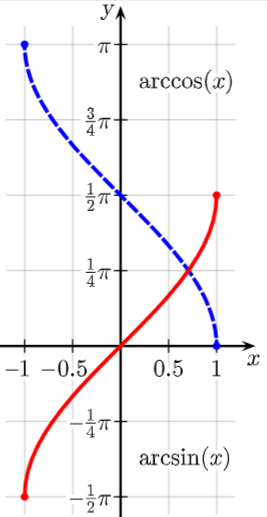
Graphiquement, on a :

La fonction arccos⁡\arccos est continue sur l'intervalle [−1 ; 1]\left[ -1 \,;\, 1 \right] et elle est dérivable sur ]−1 ; 1[\left] -1 \,;\, 1 \right[ (car demi-tangente verticale en ±1\pm 1 impliquant sa non dérivabilité en ces deux abscisses).
On a alors :
∀x∈]−1 ; 1[,  (arccos⁡)′(x)=−11−x2\forall x \in \left] -1 \,;\, 1 \right[, \,\, \big( \arccos \big)'(x) = -\dfrac{1}{\sqrt{1-x^2}}
La fonction arccos⁡\arccos n'est ni paire ni impaire, cependant on a la relation suivante :
∀x∈[−1 ; 1],  arccos⁡(−x)=π−arccos⁡(x)\forall x \in \left[ -1 \,;\, 1 \right], \,\, \arccos(-x) = \pi - \arccos(x)
De plus, on a :
∙  \bullet \,\, si x∈[0 ; π]x \in \left[ 0 \,;\, \pi \right] alors arccos⁡(cos⁡(x))=x\arccos\big( \cos(x) \big) = x
∙∙  \bullet \bullet \,\, si x∈[−1 ; 1]x \in \left[ -1 \,;\, 1 \right] alors sin⁡(arccos⁡(x))=1−x2\sin\big( \arccos(x) \big) = \sqrt{1-x^2}
∙∙∙  \bullet \bullet \bullet \,\, si x∈[−1 ; 1]x \in \left[ -1 \,;\, 1 \right] alors cos⁡(arccos⁡(x))=x\cos\big( \arccos(x) \big) = x
∙∙∙∙  \bullet \bullet \bullet \bullet \,\, si x∈]−1 ; 0[∩]0 ; 1[x \in \left] -1 \,;\, 0 \right[ \cap \left] 0 \,;\, 1 \right[ alors tan⁡(arccos⁡(x))=1−x2x\tan\big( \arccos(x) \big) = \dfrac{\sqrt{1-x^2}}{x}
Pour x∈[−1 ; 1]x \in \left[ -1 \,;\, 1 \right] la primitive de la fonction arccos⁡\arccos à pour expression : xarccos⁡(x)−1−x2+Kx\arccos(x) - \sqrt{1-x^2} + K avec K∈RK \in \mathbb{R}.
De plus, on a les graphes suivants :

Ce qui nous permet d'illustrer la propriété algébrique suivante :
∀x∈[−1 ; 1],  arccos⁡(x)+arcsin⁡(x)=π2\forall x \in \left[ -1 \,;\, 1 \right], \,\, \arccos(x) + \arcsin(x) = \dfrac{\pi}{2}
        ■■■  L′arc  tangente{\color{blue}{\bf{\,\,\,\,\,\,\,\, \blacksquare \blacksquare \blacksquare \,\, L'arc \,\, tangente }}}
La restriction de la fonction tangente à l'intervalle ]−π2 ; π2[\left] -\dfrac{\pi}{2} \,;\, \dfrac{\pi}{2} \right[ est une bijection de ]−π2 ; π2[\left] -\dfrac{\pi}{2} \,;\, \dfrac{\pi}{2} \right[ dans R\mathbb{R}.
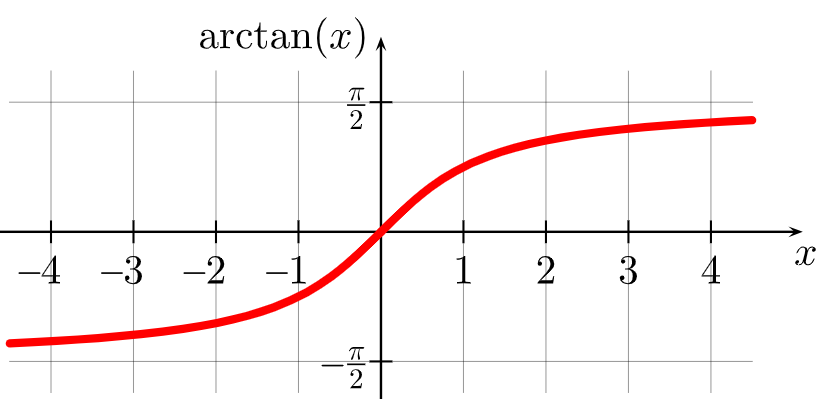
On appelle arc  tangente{\color{blue}{\bf{arc \,\, tangente}}}, que l'on note arctan⁡:R⟶]−π2 ; π2[{\color{blue}{\arctan}} : \mathbb{R} \longrightarrow \left] -\dfrac{\pi}{2} \,;\, \dfrac{\pi}{2} \right[ sa fonction réciproque. Donc arctan⁡=Rtan⁡\arctan = \mathcal{R}_{\tan}.
On a alors :
{y=arctan⁡(x)x∈R   ⟺   {x=tan⁡(y)y∈]−π2 ; π2[\left\lbrace \begin{array}{rcl} y & = & \arctan(x) \\ \\ x & \in & \mathbb{R} \\ \end{array} \right. \,\,\, \Longleftrightarrow \,\,\, \left\lbrace \begin{array}{rcl} x & = & \tan(y) \\ \\ y & \in & \left] -\dfrac{\pi}{2} \,;\, \dfrac{\pi}{2} \right[ \\ \end{array} \right.

La fonction arctan⁡\arctan est impaire et continue sur R\mathbb{R} et elle est dérivable sur R\mathbb{R}.
On a alors :
∀x∈R,  (arctan⁡)′(x)=11+x2\forall x \in \mathbb{R}, \,\, \big( \arctan \big)'(x) = \dfrac{1}{1+x^2}
De plus, on a :
∙  \bullet \,\, si x∈]−π2 ; π2[x \in \left] -\dfrac{\pi}{2} \,;\, \dfrac{\pi}{2} \right[ alors arctan⁡(tan⁡(x))=x\arctan\big( \tan(x) \big) = x
∙∙  \bullet \bullet \,\, si x∈Rx \in \mathbb{R} alors sin⁡(arctan⁡(x))=x1+x2\sin\big( \arctan(x) \big) = \dfrac{x}{\sqrt{1+x^2}}
∙∙∙  \bullet \bullet \bullet \,\, si x∈Rx \in \mathbb{R} alors cos⁡(arctan⁡(x))=11+x2\cos\big( \arctan(x) \big) = \dfrac{1}{\sqrt{1+x^2}}
∙∙∙∙  \bullet \bullet \bullet \bullet \,\, si x∈Rx \in \mathbb{R} alors tan⁡(arctan⁡(x))=x\tan\big( \arctan(x) \big) = x
Pour x∈Rx \in \mathbb{R} la primitive de la fonction arctan⁡\arctan à pour expression : xarctan⁡(x)−12ln⁡(1+x2)+Kx\arctan(x) - \dfrac{1}{2} \ln(1+x^2) + K avec K∈RK \in \mathbb{R}.
En outre, rappelons (car cela est toujours pratique) que l'on a :
▶  ∫1(1+u2)2 dx=12(u1+u2+arctan⁡(x))+K    (K∈R)\blacktriangleright \,\, \int \dfrac{1}{\big(1+u^2\big)^2} \, dx = \dfrac{1}{2} \left( \dfrac{u}{1+u^2} + \arctan(x) \right) + K \,\,\,\, (K \in \mathbb{R})
▶▶  ∫1(1+u2)3 dx=12(u(3u2+5)(1+u2)2+3arctan⁡(x))+K    (K∈R)\blacktriangleright \blacktriangleright \,\, \int \dfrac{1}{\big(1+u^2\big)^3} \, dx = \dfrac{1}{2} \left( \dfrac{u(3u^2 + 5)}{\big(1+u^2\big)^2} + 3\arctan(x) \right) + K \,\,\,\, (K \in \mathbb{R})
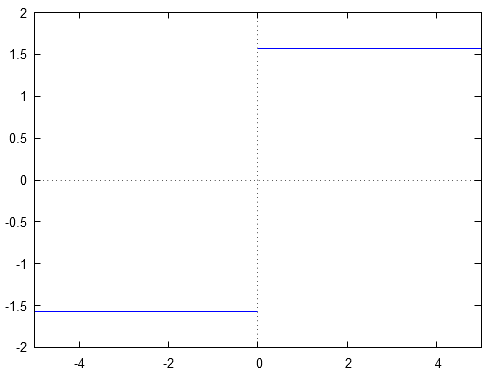
De plus, on a le graphe suivant de x∈R⋆⟼arctan⁡(x)+arctan⁡(1x)x \in \mathbb{R}^\star \longmapsto \arctan(x) + \arctan\left( \dfrac{1}{x} \right) :

Ce qui nous permet d'illustrer la propriété algébrique suivante :
∀x∈R⋆,  arctan⁡(x)+arctan⁡(1x)=signe(x)π2\forall x \in \mathbb{R}^\star, \,\, \arctan(x) + \arctan\left( \dfrac{1}{x} \right) = \mathrm{signe}(x)\dfrac{\pi}{2}
Enfin indiquons la relation très pratique suivante, pour les deux réels xx et yy tels que xy≠1xy \neq 1 :
arctan⁡(x)+arctan⁡(y)=arctan⁡(x+y1−xy)+kπ    avec  k={1sixy>1  et  (x ; y)∈(R+⋆)20sixy<1−1sixy>1  et  (x ; y)∈(R−⋆)2{\color{red}{ \arctan(x) + \arctan(y) = \arctan\left( \dfrac{x + y}{1 - xy} \right) + k \pi \,\,\,\, \mathrm{avec} \,\, k = \left\lbrace \begin{array}{rcl} 1 & \mathrm{si} & xy > 1 \,\, \mathrm{et} \,\, (x\,;\,y) \in \big( \mathrm{R}^{+\star} \big)^2 \\ \\ 0 & \mathrm{si} & xy < 1 \\ \\ -1 & \mathrm{si} & xy > 1 \,\, \mathrm{et} \,\, (x\,;\,y) \in \big( \mathrm{R}^{-\star} \big)^2 \end{array} \right.}}
        ■■■■  L′arc  cotangente{\color{blue}{\bf{\,\,\,\,\,\,\,\, \blacksquare \blacksquare \blacksquare \blacksquare \,\, L'arc \,\, cotangente }}}
La restriction de la fonction cotangente à l'intervalle ]0 ; π[\left] 0 \,;\, \pi \right[ est une bijection de ]0 ; π[\left] 0 \,;\, \pi \right[ dans R\mathbb{R}. big( \big)^2
On appelle arc  cotangente{\color{blue}{\bf{arc \,\, cotangente}}}, que l'on note arccotan:R⟶]0 ; π[{\color{blue}{\mathrm{arccotan}}} : \mathbb{R} \longrightarrow \left] 0 \,;\, \pi \right[ sa fonction réciproque. Donc arccotan=Rcotan\mathrm{arccotan} = \mathcal{R}_{\mathrm{cotan}}.
On a alors :
{y=arccotan(x)x∈R   ⟺   {x=cotan(y)y∈]0 ; π[\left\lbrace \begin{array}{rcl} y & = & \mathrm{arccotan}(x) \\ \\ x & \in & \mathbb{R} \\ \end{array} \right. \,\,\, \Longleftrightarrow \,\,\, \left\lbrace \begin{array}{rcl} x & = & \mathrm{cotan}(y) \\ \\ y & \in & \left] 0 \,;\, \pi \right[ \\ \end{array} \right.
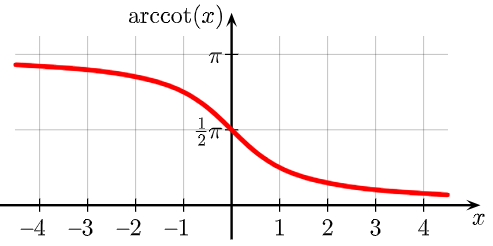
Graphiquement, on a :

La fonction arccotan\mathrm{arccotan} est continue sur R\mathbb{R} et elle est dérivable sur R\mathbb{R}.
On a alors :
∀x∈R,  (arccotan)′(x)=−11+x2\forall x \in \mathbb{R}, \,\, \big( \mathrm{arccotan} \big)'(x) = -\dfrac{1}{1+x^2}
De plus, on a :
∙  \bullet \,\, si x∈]0 ; π[x \in \left] 0 \,;\, \pi \right[ alors arccotan(cotan(x))=x\mathrm{arccotan}\big( \mathrm{cotan}(x) \big) = x
∙∙  \bullet \bullet \,\, si x∈Rx \in \mathbb{R} alors sin⁡(arccotan(x))=11+x2\sin\big( \mathrm{arccotan}(x) \big) = \dfrac{1}{\sqrt{1+x^2}}
∙∙∙  \bullet \bullet \bullet \,\, si x∈Rx \in \mathbb{R} alors cos⁡(arccotan(x))=x1+x2\cos\big( \mathrm{arccotan}(x) \big) = \dfrac{x}{\sqrt{1+x^2}}
∙∙∙∙  \bullet \bullet \bullet \bullet \,\, si x∈R⋆x \in \mathbb{R}^\star alors tan⁡(arccotan(x))=1x\tan\big( \mathrm{arccotan}(x) \big) = \dfrac{1}{x}
∙∙∙∙∙  \bullet \bullet \bullet \bullet \bullet \,\, si x∈Rx \in \mathbb{R} alors cotan(arccotan(x))=x\mathrm{cotan}\big( \mathrm{arccotan}(x) \big) = x
Pour x∈Rx \in \mathbb{R} la primitive de la fonction arccotan\mathrm{arccotan} à pour expression : x arccotan(x)+12ln⁡(1+x2)+Kx \, \mathrm{arccotan}(x) + \dfrac{1}{2} \ln(1+x^2) + K avec K∈RK \in \mathbb{R}.
De plus, on a les graphes suivants :

Ce qui nous permet d'illustrer la propriété algébrique suivante :
∀x∈R⋆,  arctan⁡(x)+arccotan(x)=π2\forall x \in \mathbb{R}^\star, \,\, \arctan(x) + \mathrm{arccotan}(x) = \dfrac{\pi}{2}
Indiquons les deux relations suivantes :
▶  \blacktriangleright \,\, Si x>0x > 0 alors on a arccotan(1x)=π2−arccotan(x)=arctan⁡(x) \mathrm{arccotan}\left( \dfrac{1}{x} \right) = \dfrac{\pi}{2} - \mathrm{arccotan}(x) = \arctan(x)
▶▶  \blacktriangleright \blacktriangleright \,\, Si x<0x < 0 alors on a arccotan(1x)=3π2−arccotan(x)=π+arctan⁡(x) \mathrm{arccotan}\left( \dfrac{1}{x} \right) = \dfrac{3\pi}{2} - \mathrm{arccotan}(x) = \pi + \arctan(x)

Signaler une erreur

Aide-nous à améliorer nos contenus en signalant les erreurs ou problèmes que tu penses avoir trouvés.

Connecte-toi ou crée un compte pour signaler une erreur.