QCM Bilan 1 - Exercice 1

2 h
165
Voici un Q.C.M. afin d'évaluer votre progression vers votre entrée dans l'enseignement supérieur.
Question 1
Cet exercice est un questionnaire à choix multiples (Q. C. M.) . Pour chacune des questions, une seule des quatre réponses est exacte.

La limite lim⁡x⟶−∞x2+x−x2+13x2+2x−3x2+x+1\lim_{x \longrightarrow -\infty} \dfrac{\sqrt{x^2 + x} - \sqrt{x^2 + 1}}{\sqrt{3x^2 + 2x} - \sqrt{3x^2 + x + 1}} vaut :
a.\bf{a.} +∞+ \infty                                                                                                           \;\;\;\;\;\;\;\;\;\;\;\;\;\;\;\;\;\;\;\;\;\;\;\;\;\;\;\;\;\;\;\;\;\;\;\;\;\;\;\;\;\;\;\;\;\;\;\;\;\;\;\;\; b.\bf{b.} 00

c.\bf{c.} 3\sqrt{3}                                                                                                               \;\;\;\;\;\;\;\;\;\;\;\;\;\;\;\;\;\;\;\;\;\;\;\;\;\;\;\;\;\;\;\;\;\;\;\;\;\;\;\;\;\;\;\;\;\;\;\;\;\;\;\;\;\;\; d.\bf{d.} n'existe pas

Correction
La bonne reˊponse est\red{\text{La bonne réponse est}} c\red{c}
Il  faut  utiliser  la  meˊthode  de  l′expression  conjugueˊe\red{\boxed{\mathrm{Il \,\,faut \,\, utiliser \,\, la \,\, méthode \,\, de \,\, l'expression \,\,conjuguée}}}
Par la méthode de l'expression conjuguée, on trouve que :
lim⁡x⟶−∞x2+x−x2+13x2+2x−3x2+x+1=lim⁡x⟶−∞3+2x+3+1x+1x21+1x+1+1x2=3+31+1=232=3\lim_{x \longrightarrow -\infty} \dfrac{\sqrt{x^2 + x} - \sqrt{x^2 + 1}}{\sqrt{3x^2 + 2x} - \sqrt{3x^2 + x + 1}} = \lim_{x \longrightarrow -\infty} \dfrac{\sqrt{3 + \dfrac{2}{x}} + \sqrt{3 + \dfrac{1}{x} + \dfrac{1}{x^2}}}{\sqrt{1 + \dfrac{1}{x}} +\sqrt{1 + \dfrac{1}{x^2}}} = \dfrac{ \sqrt{3} + \sqrt{3}}{\sqrt{1} + \sqrt{1}} = \dfrac{2\sqrt{3}}{2} = \sqrt{3}
Question 2

La limite lim⁡x⟶4x−2x2−5x+4\lim_{x \longrightarrow 4} \dfrac{\sqrt{x} - 2}{x^2 - 5x + 4} vaut :
a.\bf{a.} +∞+ \infty                                                                                                           \;\;\;\;\;\;\;\;\;\;\;\;\;\;\;\;\;\;\;\;\;\;\;\;\;\;\;\;\;\;\;\;\;\;\;\;\;\;\;\;\;\;\;\;\;\;\;\;\;\;\;\;\; b.\bf{b.} 112\dfrac{1}{12}

c.\bf{c.} 00                                                                                                                     \;\;\;\;\;\;\;\;\;\;\;\;\;\;\;\;\;\;\;\;\;\;\;\;\;\;\;\;\;\;\;\;\;\;\;\;\;\;\;\;\;\;\;\;\;\;\;\;\;\;\;\;\;\;\;\;\;\; d.\bf{d.} n'existe pas

Correction
La bonne reˊponse est\red{\text{La bonne réponse est}} b\red{b}
Il  faut  utiliser  une  factorisation  et  la  meˊthode  de  l′expression  conjugueˊe\red{\boxed{\mathrm{Il \,\,faut \,\, utiliser \,\, une \,\, factorisation \,\, et \,\, la \,\, méthode \,\, de \,\, l'expression \,\,conjuguée}}}
En effet, on a :
lim⁡x⟶4x−2x2−5x+4=lim⁡x⟶4x−2(x−1)(x−4)=lim⁡x⟶4x−2(x−1)(x−4)×x+2x+2=lim⁡x⟶4x2−22(x−1)(x−4)×1x+2=lim⁡x⟶4x−4(x−1)(x−4)×1x+2\lim_{x \longrightarrow 4} \dfrac{\sqrt{x} - 2}{x^2 - 5x + 4} = \lim_{x \longrightarrow 4} \dfrac{\sqrt{x} - 2}{(x-1)(x-4)} = \lim_{x \longrightarrow 4} \dfrac{\sqrt{x} - 2}{(x-1)(x-4)} \times \dfrac{\sqrt{x} + 2}{\sqrt{x} + 2} = \lim_{x \longrightarrow 4} \dfrac{\sqrt{x}^2 - 2^2}{(x-1)(x-4)} \times \dfrac{1}{\sqrt{x} + 2} = \lim_{x \longrightarrow 4} \dfrac{x - 4}{(x-1)(x-4)} \times \dfrac{1}{\sqrt{x} + 2}
Ce qui nous donne en simplifiant par (x−4)(x-4) :
lim⁡x⟶4x−2x2−5x+4=lim⁡x⟶41(x−1) (x+2)=1(4−1) (4+2)=13 (2+2)=13×4=112\lim_{x \longrightarrow 4} \dfrac{\sqrt{x} - 2}{x^2 - 5x + 4} = \lim_{x \longrightarrow 4} \dfrac{1}{(x-1) \, (\sqrt{x} + 2)} = \dfrac{1}{(4-1) \, (\sqrt{4} + 2)} = \dfrac{1}{3 \, (2 + 2)} = \dfrac{1}{3 \times 4} = \dfrac{1}{12}
Question 3

La limite lim⁡x⟶1x3−1x−1\lim_{x \longrightarrow 1} \dfrac{\sqrt[3]{x} - 1}{x-1} vaut :
a.\bf{a.} 11                                                                                                           \;\;\;\;\;\;\;\;\;\;\;\;\;\;\;\;\;\;\;\;\;\;\;\;\;\;\;\;\;\;\;\;\;\;\;\;\;\;\;\;\;\;\;\;\;\;\;\;\;\;\;\;\; b.\bf{b.} 112\dfrac{1}{12}

c.\bf{c.} 00                                                                                                             \;\;\;\;\;\;\;\;\;\;\;\;\;\;\;\;\;\;\;\;\;\;\;\;\;\;\;\;\;\;\;\;\;\;\;\;\;\;\;\;\;\;\;\;\;\;\;\;\;\;\;\;\;\; d.\bf{d.} 13\dfrac{1}{3}

Correction
La bonne reˊponse est\red{\text{La bonne réponse est}} d\red{d}
Il  faut  utiliser  la  deˊfinition  du  nombre  deˊriveˊe  en  x=1\red{\boxed{\mathrm{Il \,\,faut \,\, utiliser \,\, la \,\, définition \,\, du \,\, nombre \,\, dérivée \,\, en} \,\, x=1 }}
En effet, en utilisant la définition de la dérivée en 11, on trouve que :
lim⁡x⟶1x3−1x−1=(x3)′(x=1)=(x13)′(x=1)=(13x13−1)(x=1)=(13x−23)(x=1)=13×1−23=13×1=13\lim_{x \longrightarrow 1} \dfrac{\sqrt[3]{x} - 1}{x-1} = \left( \sqrt[3]{x} \right)'(x=1) = \left( x^{\frac{1}{3}} \right)'(x=1) = \left( \dfrac{1}{3} x^{\frac{1}{3}-1} \right)(x=1) = \left( \dfrac{1}{3} x^{-\frac{2}{3}} \right)(x=1) = \dfrac{1}{3} \times 1^{-\frac{2}{3}} = \dfrac{1}{3} \times 1 = \dfrac{1}{3}
Question 4

La limite lim⁡x⟶1x2+x−x2+13x2+2x−3x2+x+1\lim_{x \longrightarrow 1} \dfrac{\sqrt{x^2 + x} - \sqrt{x^2 + 1}}{\sqrt{3x^2 + 2x} - \sqrt{3x^2 + x + 1}} vaut :
a.\bf{a.} +∞+ \infty                                                                                                           \;\;\;\;\;\;\;\;\;\;\;\;\;\;\;\;\;\;\;\;\;\;\;\;\;\;\;\;\;\;\;\;\;\;\;\;\;\;\;\;\;\;\;\;\;\;\;\;\;\;\;\;\; b.\bf{b.} 00

c.\bf{c.} 11                                                                                                               \;\;\;\;\;\;\;\;\;\;\;\;\;\;\;\;\;\;\;\;\;\;\;\;\;\;\;\;\;\;\;\;\;\;\;\;\;\;\;\;\;\;\;\;\;\;\;\;\;\;\;\;\;\;\; d.\bf{d.} 52\sqrt{\dfrac{5}{2}}

Correction
La bonne reˊponse est\red{\text{La bonne réponse est}} d\red{d}
Il  faut  utiliser  la  meˊthode  de  factorisation  par  le  terme  de  puissance  la  plus  importante\red{\boxed{\mathrm{Il \,\,faut \,\, utiliser \,\, la \,\, méthode \,\, de \,\, factorisation \,\, par \,\, le \,\, terme \,\, de \,\, puissance \,\, la \,\, plus \,\, importante }}}
En factorisant par x2x^2 dans chacune des racines carrées présentent, on trouve que :
lim⁡x⟶1x2+x−x2+13x2+2x−3x2+x+1=lim⁡x⟶13+2x+3+1x+1x21+1x+1+1x2=3+21+3+11+1121+11+1+112=3+2+3+1+11+1+1+1=5+52+2=2522=52=52\lim_{x \longrightarrow 1} \dfrac{\sqrt{x^2 + x} - \sqrt{x^2 + 1}}{\sqrt{3x^2 + 2x} - \sqrt{3x^2 + x + 1}} = \lim_{x \longrightarrow 1} \dfrac{\sqrt{3 + \dfrac{2}{x}} + \sqrt{3 + \dfrac{1}{x} + \dfrac{1}{x^2}}}{\sqrt{1 + \dfrac{1}{x}} +\sqrt{1 + \dfrac{1}{x^2}}} = \dfrac{\sqrt{3 + \dfrac{2}{1}} + \sqrt{3 + \dfrac{1}{1} + \dfrac{1}{1^2}}}{\sqrt{1 + \dfrac{1}{1}} +\sqrt{1 + \dfrac{1}{1^2}}} = \dfrac{\sqrt{3 + 2} + \sqrt{3 + 1 + 1}}{\sqrt{1 + 1} +\sqrt{1 + 1}} = \dfrac{\sqrt{5}+\sqrt{5}} {\sqrt{2}+\sqrt{2}} = \dfrac{2\sqrt{5}}{2\sqrt{2}} = \dfrac{\sqrt{5}}{\sqrt{2}} = \sqrt{\dfrac{5}{2}}
Question 5

On considère les trois nombres réels strictement positifs aa, α\alpha et β\beta.
La limite lim⁡x⟶axα−aαxβ−aβ\lim_{x \longrightarrow a} \dfrac{x^\alpha - a^\alpha}{x^\beta - a^\beta} vaut :
a.\bf{a.} aαβa^{\frac{\alpha}{\beta}}                                                                                                           \;\;\;\;\;\;\;\;\;\;\;\;\;\;\;\;\;\;\;\;\;\;\;\;\;\;\;\;\;\;\;\;\;\;\;\;\;\;\;\;\;\;\;\;\;\;\;\;\;\;\;\;\; b.\bf{b.} αβ\dfrac{\alpha}{\beta}

c.\bf{c.} aα−βa^{\alpha - \beta}                                                                                                     \;\;\;\;\;\;\;\;\;\;\;\;\;\;\;\;\;\;\;\;\;\;\;\;\;\;\;\;\;\;\;\;\;\;\;\;\;\;\;\;\;\;\;\;\;\;\;\;\;\; d.\bf{d.} αβaα−β\dfrac{\alpha}{\beta} a^{\alpha - \beta}

Correction
La bonne reˊponse est\red{\text{La bonne réponse est}} d\red{d}
Il  faut  utiliser  un  jeu  d′eˊcriture  et  la  deˊfinition  du  nombre  deˊriveˊe  en  x=a\red{\boxed{\mathrm{Il \,\,faut \,\, utiliser \,\, un \,\, jeu \,\, d'écriture \,\, et \,\, la \,\, définition \,\, du \,\, nombre \,\, dérivée \,\, en} \,\, x=a }}
En effet, on a :
lim⁡x⟶axα−aαxβ−aβ=lim⁡x⟶a(xα−aαx−a×x−axβ−aβ)=lim⁡x⟶a(xα−aαx−a×1xβ−aβx−a)=lim⁡x⟶axα−aαx−a×1lim⁡x⟶axβ−aβx−a\lim_{x \longrightarrow a} \dfrac{x^\alpha - a^\alpha}{x^\beta - a^\beta} = \lim_{x \longrightarrow a} \left( \dfrac{x^\alpha - a^\alpha}{x - a} \times \dfrac{x- a}{x^\beta - a^\beta} \right) = \lim_{x \longrightarrow a} \left( \dfrac{x^\alpha - a^\alpha}{x - a} \times \dfrac{1}{\dfrac{x^\beta - a^\beta}{x- a}} \right) = \lim_{x \longrightarrow a} \dfrac{x^\alpha - a^\alpha}{x - a} \times \dfrac{1}{\displaystyle{\lim_{x \longrightarrow a}} \dfrac{x^\beta - a^\beta}{x- a}}
On reconnait alors la définition de la dérivation en aa, et on obtient alors :
lim⁡x⟶axα−aαxβ−aβ=(xα)′(x=a)(xβ)′(x=a)=(αxα−1)(x=a)(βxβ−1)(x=a)=αaα−1βaβ−1=αβaα−1aβ−1=αβaα−1−(β−1)=αβaα−1−β+1=αβaα−β\lim_{x \longrightarrow a} \dfrac{x^\alpha - a^\alpha}{x^\beta - a^\beta} = \dfrac{\left( x^\alpha \right)'(x=a)}{\left( x^\beta \right)'(x=a)} = \dfrac{\left( \alpha x^{\alpha-1} \right)(x=a)}{\left( \beta x^{\beta-1} \right)(x=a)} = \dfrac{\alpha a^{\alpha-1}}{\beta a^{\beta-1}} = \dfrac{\alpha}{\beta} \dfrac{a^{\alpha-1}}{a^{\beta-1}} = \dfrac{\alpha}{\beta} a^{\alpha-1 - (\beta-1)} = \dfrac{\alpha}{\beta} a^{\alpha-1 - \beta + 1} = \dfrac{\alpha}{\beta} a^{\alpha-\beta }
Question 6

Soit x∈[π4 ; π3]x \in \left[ \dfrac{\pi}{4} \,;\ \dfrac{\pi}{3} \right]. L'expression f′f' de la dérivée de f(x)=1sin⁡(1x)f(x) = \dfrac{1}{\sin\left( \dfrac{1}{x} \right)} est :

a.\bf{a.} f′(x)=1cos⁡(1x)f'(x) = \dfrac{1}{\cos\left( \dfrac{1}{x} \right)}                                                                                           \;\;\;\;\;\;\;\;\;\;\;\;\;\;\;\;\;\;\;\;\;\;\;\;\;\;\;\;\;\;\;\;\;\;\;\;\;\;\;\;\;\;\;\;\; b.\bf{b.} f′(x)=1x2sin⁡2(1x)f'(x) = \dfrac{1}{x^2 \sin^2\left( \dfrac{1}{x} \right)}

c.\bf{c.} f′(x)=1x2cos⁡(1x)tan⁡2(1x)f'(x) = \dfrac{1}{x^2 \cos\left( \dfrac{1}{x} \right) \tan^2\left( \dfrac{1}{x} \right)}                                                   \;\;\;\;\;\;\;\;\;\;\;\;\;\;\;\;\;\;\;\;\;\;\;\;\; d.\bf{d.} f′(x)=−cos⁡(1x)x2sin⁡2(1x)f'(x) = \dfrac{-\cos\left( \dfrac{1}{x} \right) }{x^2 \sin^2\left( \dfrac{1}{x} \right)}

Correction
La bonne reˊponse est\red{\text{La bonne réponse est}} c\red{c}
Il  faut  utiliser  la  formule  de  deˊrivation  suivante  :  (1f)′=−f′f2\red{\boxed{\mathrm{Il \,\,faut \,\, utiliser \,\, la \,\, formule \,\, de \,\, dérivation \,\, suivante \,\, : } \,\, \left(\dfrac{1}{f}\right)' = \dfrac{-f'}{f^2} }}
En effet, soit x∈[π4 ; π3]x \in \left[ \dfrac{\pi}{4} \,;\ \dfrac{\pi}{3} \right]. L'expression f′f' de la dérivée de f(x)=1sin⁡(1x)f(x) = \dfrac{1}{\sin\left( \dfrac{1}{x} \right)} est :
f′(x)=−(sin⁡(1x))′sin⁡2(1x)=−(1x)′×cos⁡(1x)sin⁡2(1x)=−−1x2×cos⁡(1x)sin⁡2(1x)=cos⁡(1x)x2sin⁡2(1x)=cos⁡2(1x)x2cos⁡(1x)sin⁡2(1x)=1x2cos⁡(1x)sin⁡2(1x)cos⁡2(1x)=1x2cos⁡(1x)tan⁡2(1x)f'(x) = \dfrac{-\left( \sin\left( \dfrac{1}{x} \right) \right)'}{\sin^2\left( \dfrac{1}{x} \right)} = \dfrac{- \left( \dfrac{1}{x} \right)' \times \cos\left( \dfrac{1}{x} \right) }{\sin^2\left( \dfrac{1}{x} \right)} = \dfrac{- \dfrac{-1}{x^2} \times \cos\left( \dfrac{1}{x} \right) }{\sin^2\left( \dfrac{1}{x} \right)} = \dfrac{\cos\left( \dfrac{1}{x} \right) }{x^2 \sin^2\left( \dfrac{1}{x} \right)} = \dfrac{\cos^2\left( \dfrac{1}{x} \right) }{x^2 \cos\left( \dfrac{1}{x} \right) \sin^2\left( \dfrac{1}{x} \right)} = \dfrac{1}{x^2 \cos\left( \dfrac{1}{x} \right) \dfrac{ \sin^2\left( \dfrac{1}{x} \right)}{\cos^2\left( \dfrac{1}{x} \right) }} = \dfrac{1}{x^2 \cos\left( \dfrac{1}{x} \right) \tan^2\left( \dfrac{1}{x} \right)}
Question 7

Soit 0<x<0,30 < x < 0,3. L'expression f′f' de la dérivée de f(x)=ln⁡(cos⁡2(x+1)f(x) = \ln\left( \cos^2(\sqrt{x} + 1 \right) est :

a.\bf{a.} f′(x)=tan⁡(x+1)f'(x) = \tan(\sqrt{x} + 1 )                                                         \;\;\;\;\;\;\;\;\;\;\;\;\;\;\;\;\;\;\;\;\;\;\;\;\;\;\;\; b.\bf{b.} f′(x)=xtan⁡(x+1)f'(x) = \sqrt{x}\tan(\sqrt{x} + 1 )

c.\bf{c.} f′(x)=−tan⁡(x+1)xf'(x) = -\dfrac{\tan(\sqrt{x} + 1 )}{\sqrt{x}}                                                   \;\;\;\;\;\;\;\;\;\;\;\;\;\;\;\;\;\;\;\;\;\;\;\;\; d.\bf{d.} f′(x)=−tan⁡2(x+1)xf'(x) = -\dfrac{\tan^2(\sqrt{x} + 1 )}{\sqrt{x}}

Correction
La bonne reˊponse est\red{\text{La bonne réponse est}} c\red{c}
Il  faut  utiliser  la  formule  de  deˊrivation  suivante  :  (ln⁡(f))′=f′f\red{\boxed{\mathrm{Il \,\,faut \,\, utiliser \,\, la \,\, formule \,\, de \,\, dérivation \,\, suivante \,\, : } \,\, \left(\ln(f)\right)' = \dfrac{f'}{f} }}
En effet, on a :
f′(x)=(ln⁡(cos⁡2(x+1)))′=(cos⁡2(x+1))′cos⁡2(x+1)=2cos⁡(x+1)(cos⁡(x+1))′cos⁡2(x+1)=2cos⁡(x+1)×(x+1)′×−sin⁡(x+1)cos⁡2(x+1)f'(x) = \left(\ln\left( \cos^2(\sqrt{x} + 1) \right)\right)' = \dfrac{\left( \cos^2(\sqrt{x} + 1) \right)'}{\cos^2(\sqrt{x} + 1)} = \dfrac{2 \cos(\sqrt{x} + 1) \left( \cos(\sqrt{x} + 1) \right)'}{\cos^2(\sqrt{x} + 1)} = \dfrac{2 \cos(\sqrt{x} + 1) \times (\sqrt{x} + 1)' \times -\sin(\sqrt{x} + 1) }{\cos^2(\sqrt{x} + 1)}
Ce qui nous donne :
f′(x)=2cos⁡(x+1)×12x×−sin⁡(x+1)cos⁡2(x+1)=−1xsin⁡(x+1)cos⁡(x+1)=−tan⁡(x+1)xf'(x) = \dfrac{2 \cos(\sqrt{x} + 1) \times \dfrac{1}{2\sqrt{x}} \times -\sin(\sqrt{x} + 1) }{\cos^2(\sqrt{x} + 1)} = - \dfrac{ \dfrac{1}{\sqrt{x}} \sin(\sqrt{x} + 1) }{\cos(\sqrt{x} + 1)} = -\dfrac{\tan(\sqrt{x} + 1 )}{\sqrt{x}}
Question 8

Soit x>0x>0. L'expression f′f' de la dérivée de f(x)=cos⁡2(ln⁡(x+1))f(x) = \cos^2\left( \ln \left(\sqrt{x} + 1 \right) \right) est :

a.\bf{a.} f′(x)=−sin⁡(2ln⁡(x+1))2x(x+1)f'(x) = - \dfrac{\sin \left(2 \ln\left( \sqrt{x} +1 \right) \right)}{2\sqrt{x}\left(\sqrt{x}+1\right)}                                                         \;\;\;\;\;\;\;\;\;\;\;\;\;\;\;\;\;\;\;\;\;\;\;\;\;\;\;\; b.\bf{b.} f′(x)=−sin⁡(2ln⁡(x+1))2(x+1)f'(x) = - \dfrac{\sin \left(2 \ln\left( \sqrt{x} +1 \right) \right)}{2\left(\sqrt{x}+1\right)}

c.\bf{c.} f′(x)=−12(x+1)f'(x) = - \dfrac{1}{2\left(\sqrt{x}+1\right)}                                                   \;\;\;\;\;\;\;\;\;\;\;\;\;\;\;\;\;\;\;\;\;\;\;\;\; d.\bf{d.} f′(x)=−sin⁡(x+1)x+xf'(x) = -\dfrac{\sin(\sqrt{x} + 1 )}{x +\sqrt{x}}

Correction
La bonne reˊponse est\red{\text{La bonne réponse est}} a\red{a}
Il  faut  utiliser  la  formule  de  deˊrivation  suivante  :  (f2)′=2f′f\red{\boxed{\mathrm{Il \,\,faut \,\, utiliser \,\, la \,\, formule \,\, de \,\, dérivation \,\, suivante \,\, : } \,\, \left(f^2\right)' = 2 f'f }}
En effet, on a :
f′(x)=(cos⁡2(ln⁡(x+1)))′=2cos⁡(ln⁡(x+1))(cos⁡(ln⁡(x+1)))′=2cos⁡(ln⁡(x+1))(ln⁡(x+1))′×−sin⁡(ln⁡(x+1))f'(x) = \left( \cos^2\left( \ln \left(\sqrt{x} + 1 \right) \right) \right)'= 2 \cos\left( \ln \left(\sqrt{x} + 1 \right) \right) \left( \cos\left( \ln \left(\sqrt{x} + 1 \right) \right) \right)' = 2 \cos\left( \ln \left(\sqrt{x} + 1 \right) \right) \left( \ln \left(\sqrt{x} + 1 \right) \right)' \times -\sin\left( \ln \left(\sqrt{x} + 1 \right) \right)
Mais (ln⁡(x+1))′=(x+1)′x+1=12xx+1=12x(x+1)\left( \ln \left(\sqrt{x} + 1 \right) \right)' = \dfrac{(\sqrt{x} + 1 )'}{\sqrt{x} + 1 } = \dfrac{ \dfrac{1}{2\sqrt{x}} }{\sqrt{x} + 1 } = \dfrac{1}{2\sqrt{x} \left( \sqrt{x} + 1 \right)}. Ainsi, on obtient :
f′(x)=−2cos⁡(ln⁡(x+1))12x(x+1)sin⁡(ln⁡(x+1))=−2cos⁡(ln⁡(x+1))sin⁡(ln⁡(x+1))2x(x+1)f'(x) = - 2 \cos\left( \ln \left(\sqrt{x} + 1 \right) \right) \dfrac{1}{2\sqrt{x} \left( \sqrt{x} + 1 \right)} \sin\left( \ln \left(\sqrt{x} + 1 \right) \right) = - \dfrac{2 \cos\left( \ln \left(\sqrt{x} + 1 \right) \right) \sin\left( \ln \left(\sqrt{x} + 1 \right) \right) }{2\sqrt{x} \left( \sqrt{x} + 1 \right)}
Mais pour tout XX réel, on sait que 2cos⁡(X)sin⁡(X)=sin⁡(2X)2 \cos(X) \sin(X) = \sin(2X). Finalement, on trouve que :
f′(x)=−sin⁡(2ln⁡(x+1))2x(x+1)f'(x) = - \dfrac{\sin\left( 2\ln \left(\sqrt{x} + 1 \right) \right) }{2\sqrt{x} \left( \sqrt{x} + 1 \right)}
Question 9

Soit x⩾2x \geqslant 2. L'expression f′f' de la dérivée de f(x)=ln⁡(ln⁡(ln⁡(x2)))f(x) = \ln \left( \ln \left( \ln \left( x^2\right) \right) \right) est :

a.\bf{a.} f′(x)=1ln⁡(x)ln⁡(ln⁡(x2))f'(x) = \dfrac{1}{\ln(x) \ln \left( \ln(x^2)\right)}                                                         \;\;\;\;\;\;\;\;\;\;\;\;\;\;\;\;\;\;\;\;\;\;\;\;\;\;\;\; b.\bf{b.} f′(x)=1xln⁡(x)ln⁡(2ln⁡(x))f'(x) = \dfrac{1}{x \ln(x) \ln \left( 2 \ln(x)\right)}

c.\bf{c.} f′(x)=−xln⁡(x)ln⁡(2ln⁡(x))f'(x) = - \dfrac{x}{\ln(x) \ln \left( 2\ln(x)\right)}                                                   \;\;\;\;\;\;\;\;\;\;\;\;\;\;\;\;\;\;\;\;\;\;\;\;\; d.\bf{d.} f′(x)=2ln⁡(ln⁡(x))f'(x) = 2\ln(\ln(x))

Correction
La bonne reˊponse est\red{\text{La bonne réponse est}} b\red{b}
Il  faut  utiliser  la  formule  de  deˊrivation  suivante  :  (ln⁡(f))′=f′f\red{\boxed{\mathrm{Il \,\,faut \,\, utiliser \,\, la \,\, formule \,\, de \,\, dérivation \,\, suivante \,\, : } \,\, \left(\ln(f)\right)' = \dfrac{f'}{f} }}
En effet, pour x⩾2x \geqslant 2, on a :
f′(x)=(ln⁡(ln⁡(ln⁡(x2))))′=(ln⁡(ln⁡(x2)))′ln⁡(ln⁡(x2))=(ln⁡(x2))′ln⁡(x2)ln⁡(ln⁡(x2))=(x2)′x2ln⁡(x2)ln⁡(ln⁡(x2))=2xx2ln⁡(x2)ln⁡(ln⁡(x2))=2xln⁡(x2)ln⁡(ln⁡(x2))=2x2ln⁡(x)ln⁡(ln⁡(x2))=1xln⁡(x)ln⁡(ln⁡(x2))=1xln⁡(x)ln⁡(ln⁡(x2))=1xln⁡(x)ln⁡(ln⁡(x2))f'(x) = \left( \ln \left( \ln \left( \ln \left( x^2\right) \right) \right) \right)'= \dfrac{\left( \ln \left( \ln \left( x^2\right) \right) \right)'}{\ln \left( \ln \left( x^2\right) \right)} = \dfrac{\dfrac{\left( \ln \left( x^2\right) \right)'}{\ln \left( x^2\right)}}{\ln \left( \ln \left( x^2\right) \right)} = \dfrac{\dfrac{\dfrac{(x^2)'}{x^2}}{\ln \left( x^2\right)}}{\ln \left( \ln \left( x^2\right) \right)} = \dfrac{\dfrac{\dfrac{2x}{x^2}}{\ln \left( x^2\right)}}{\ln \left( \ln \left( x^2\right) \right)} = \dfrac{\dfrac{\dfrac{2}{x}}{\ln \left( x^2\right)}}{\ln \left( \ln \left( x^2\right) \right)} = \dfrac{\dfrac{\dfrac{2}{x}}{2\ln(x)}}{\ln \left( \ln \left( x^2\right) \right)} = \dfrac{\dfrac{\dfrac{1}{x}}{\ln(x)}}{\ln \left( \ln \left( x^2\right) \right)} = \dfrac{\dfrac{1}{x\ln(x)}}{\ln \left( \ln \left( x^2\right) \right)} = \dfrac{1}{x\ln(x)\ln \left( \ln \left( x^2\right) \right)}
Mais comme ln⁡(x2)=2ln⁡(x)\ln(x^2) = 2 \ln(x), on a :
f′(x)=1xln⁡(x)ln⁡(2ln⁡(x))f'(x) = \dfrac{1}{x \ln(x) \ln \left( 2 \ln(x)\right)}
Question 10

On considère la fonction numérique ff suivante :
f:{x⟼[ 0 ; 1 ]x⟶∣ sin⁡(x) ∣f : \left\lbrace \begin{array}{rcl} x & \longmapsto & [\,0\,;\,1\,] \\ & & \\ x & \longrightarrow & |\, \sin(x)\,| \end{array} \right.
Cette fonction est :
a.\bf{a.} dérivable à l'origine                                                         \;\;\;\;\;\;\;\;\;\;\;\;\;\;\;\;\;\;\;\;\;\;\;\;\;\;\;\; b.\bf{b.} non dérivable à l'origine

c.\bf{c.} discontinue à l'origne                                                     \;\;\;\;\;\;\;\;\;\;\;\;\;\;\;\;\;\;\;\;\;\;\;\;\;\; d.\bf{d.} inexistante à l'origine

Correction
La bonne reˊponse est\red{\text{La bonne réponse est}} a\red{a}
Il  faut  utiliser  la  deˊfinition  du  taux  de  variation  (deˊriveˊe)  en  x=0+  et  en  x=0−\red{\boxed{\mathrm{Il \,\,faut \,\, utiliser \,\, la \,\, définition \,\, du \,\, taux \,\, de \,\, variation \,\, (dérivée) \,\, en} \,\, x=0^+ \,\, \mathrm{et \,\, en \,\,} x=0^- }}
En effet, on a :
lim⁡x⟶0±f(x)−f(0)x−0=lim⁡x⟶0±∣ sin⁡(x) ∣−∣ sin⁡(0) ∣x=lim⁡x⟶0±∣ sin⁡(x) ∣−∣ 0 ∣x=lim⁡x⟶0±∣ sin⁡(x) ∣x\lim_{x \longrightarrow 0^\pm} \dfrac{f(x) - f(0)}{x - 0} = \lim_{x \longrightarrow 0^\pm} \dfrac{|\, \sin(x)\,| - |\, \sin(0)\,|}{x} = \lim_{x \longrightarrow 0^\pm} \dfrac{|\, \sin(x)\,| - |\, 0 \,|}{x} = \lim_{x \longrightarrow 0^\pm} \dfrac{|\, \sin(x)\,|}{x}
Or, lorsque xx tend vers 00, le terme sin⁡(x)\sin(x) est équivalent à xx. Ce qui nous permet d'écrire que :
lim⁡x⟶0±f(x)−f(0)x−0=lim⁡x⟶0±∣ x ∣x\lim_{x \longrightarrow 0^\pm} \dfrac{f(x) - f(0)}{x - 0} = \lim_{x \longrightarrow 0^\pm} \dfrac{|\, x \,|}{x}
  ∙  \,\, \bullet \,\, si x⟶0+x \longrightarrow 0^+ alors x>0x>0 et ∣ x ∣=x|\, x \,| = x
Dans ce cas, on a :
lim⁡x⟶0+f(x)−f(0)x−0=lim⁡x⟶0+xx=lim⁡x⟶0+1=1\lim_{x \longrightarrow 0^+} \dfrac{f(x) - f(0)}{x - 0} = \lim_{x \longrightarrow 0^+} \dfrac{x}{x} = \lim_{x \longrightarrow 0^+} 1 = 1
  ∙∙  \,\, \bullet \bullet \,\, si x⟶0−x \longrightarrow 0^- alors x<0x<0 et ∣ x ∣=−x|\, x \,| = -x
Dans ce cas, on a :
lim⁡x⟶0−f(x)−f(0)x−0=lim⁡x⟶0−−xx=lim⁡x⟶0−−1=−1\lim_{x \longrightarrow 0^-} \dfrac{f(x) - f(0)}{x - 0} = \lim_{x \longrightarrow 0^-} \dfrac{-x}{x} = \lim_{x \longrightarrow 0^-} -1 = -1
On constate alors que :
lim⁡x⟶0+f(x)−f(0)x−0≠lim⁡x⟶0−f(x)−f(0)x−0\lim_{x \longrightarrow 0^+} \dfrac{f(x) - f(0)}{x - 0} \neq \lim_{x \longrightarrow 0^-} \dfrac{f(x) - f(0)}{x - 0}
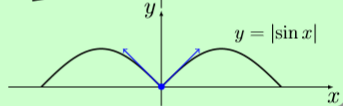
Donc la fonction ff n'est pas dérivable à l'origine. Il y a l'existence de deux tangentes différentes au point origine.
Graphiquement, ceci se visualise très bien :
Question 11

La valeur de l'intégrale ∫0π3sin⁡(x)2−cos⁡(x) dx\int_{0}^{\frac{\pi}{3}} \dfrac{\sin(x)}{2 - \cos(x)} \, dx est :
a.\bf{a.} 00                                                                         \;\;\;\;\;\;\;\;\;\;\;\;\;\;\;\;\;\;\;\;\;\;\;\;\;\;\;\;\;\;\;\;\;\;\;\; b.\bf{b.} π3\dfrac{\pi}{3}
c.\bf{c.} ln⁡(32)\ln \left(\dfrac{3}{2} \right)                                                     \;\;\;\;\;\;\;\;\;\;\;\;\;\;\;\;\;\;\;\;\;\;\;\;\;\; d.\bf{d.} ln⁡(π2)\ln \left(\dfrac{\sqrt{\pi}}{2} \right)

Correction
La bonne reˊponse est\red{\text{La bonne réponse est}} c\red{c}
Il  faut  penser  aˋ  la  formule  suivante  :  (ln⁡(f))′=f′f\red{\boxed{\mathrm{Il \,\,faut \,\, penser \,\, à \,\, la \,\, formule \,\, suivante \,\, : } \,\, \left(\ln(f)\right)' = \dfrac{f'}{f} }}
En effet, on a :
∫0π3sin⁡(x)2−cos⁡(x) dx=∫0π3(2−cos⁡(x))′2−cos⁡(x) dx=[ln⁡(2−cos⁡(x))]0π3=ln⁡(2−cos⁡(π3))−ln⁡(2−cos⁡(0))=ln⁡(2−12)−ln⁡(2−1)=ln⁡(32)−ln⁡(1)=ln⁡(32)−0=ln⁡(32)\int_{0}^{\frac{\pi}{3}} \dfrac{\sin(x)}{2 - \cos(x)} \, dx = \int_{0}^{\frac{\pi}{3}} \dfrac{\left( 2 - \cos(x) \right)'}{2 - \cos(x)} \, dx = [\ln\left( 2 - \cos(x) \right)]_{0}^{\frac{\pi}{3}} = \ln\left( 2 - \cos\left( \dfrac{\pi}{3} \right) \right) - \ln\left( 2 - \cos\left( 0 \right) \right) = \ln\left( 2 - \dfrac{1}{2} \right) - \ln\left( 2 - 1 \right) = \ln\left( \dfrac{3}{2} \right) - \ln\left( 1 \right) = \ln\left( \dfrac{3}{2} \right) - 0 = \ln\left( \dfrac{3}{2} \right)
Question 12

La valeur de l'intégrale ∫0π41+tan⁡(x)cos⁡2(x) dx\int_{0}^{\frac{\pi}{4}} \dfrac{1+\tan(x)}{\cos^2(x)} \, dx est :
a.\bf{a.} 00                                                                         \;\;\;\;\;\;\;\;\;\;\;\;\;\;\;\;\;\;\;\;\;\;\;\;\;\;\;\;\;\;\;\;\;\;\;\; b.\bf{b.} 32\dfrac{3}{2}
c.\bf{c.} ln⁡(π4)\ln \left(\dfrac{\pi}{4} \right)                                                       \;\;\;\;\;\;\;\;\;\;\;\;\;\;\;\;\;\;\;\;\;\;\;\;\;\;\; d.\bf{d.} π4\dfrac{\pi}{4}

Correction
La bonne reˊponse est\red{\text{La bonne réponse est}} b\red{b}
Il  faut  penser  aˋ  une  deˊcomposition  simple  et  aux  deux  formules  suivantes  :  (f2)′=2f′f  et  (tan⁡(x))′=1cos⁡2(x)\red{\boxed{\mathrm{Il \,\,faut \,\, penser \,\, à \,\, une \,\, décomposition \,\, simple \,\, et \,\, aux \,\, deux \,\, formules \,\, suivantes \,\, : } \,\, \left( f^2 \right)'= 2f'f \,\, \mathrm{et} \,\, \left(\tan(x)\right)' = \dfrac{1}{\cos^2(x)} }}
En effet, on a :
∫0π41+tan⁡(x)cos⁡2(x) dx=∫0π4(1cos⁡2(x)+tan⁡(x)cos⁡2(x)) dx=∫0π41cos⁡2(x) dx+∫0π41cos⁡2(x)tan⁡(x) dx=∫0π41cos⁡2(x) dx+12∫0π421cos⁡2(x)tan⁡(x) dx\int_{0}^{\frac{\pi}{4}} \dfrac{1+\tan(x)}{\cos^2(x)} \, dx = \int_{0}^{\frac{\pi}{4}} \left( \dfrac{1}{\cos^2(x)} + \dfrac{\tan(x)}{\cos^2(x)} \right) \, dx = \int_{0}^{\frac{\pi}{4}} \dfrac{1}{\cos^2(x)} \, dx + \int_{0}^{\frac{\pi}{4}} \dfrac{1}{\cos^2(x)} \tan(x) \, dx = \int_{0}^{\frac{\pi}{4}} \dfrac{1}{\cos^2(x)} \, dx + \dfrac{1}{2}\int_{0}^{\frac{\pi}{4}} 2\dfrac{1}{\cos^2(x)} \tan(x) \, dx
Or le terme 1cos⁡2(x)\dfrac{1}{\cos^2(x)} est la dérivée de tan⁡(x)\tan(x). Ainsi, on obtient :
∫0π41+tan⁡(x)cos⁡2(x) dx=[tan⁡(x)]0π4+12[tan⁡2(x)]0π4=tan⁡(π4)−tan⁡(0)+tan⁡2(π4)−tan⁡2(0)2=1−0+1−02=32\int_{0}^{\frac{\pi}{4}} \dfrac{1+\tan(x)}{\cos^2(x)} \, dx = [\tan(x)]_{0}^{\frac{\pi}{4}} + \dfrac{1}{2} [\tan^2(x)]_{0}^{\frac{\pi}{4}} = \tan\left( \dfrac{\pi}{4} \right) - \tan(0) + \dfrac{\tan^2\left( \dfrac{\pi}{4} \right) - \tan^2(0)}{2} = 1 - 0 + \dfrac{1 - 0}{2} = \dfrac{3}{2}
Question 13

La valeur de l'intégrale ∫1e(xln⁡2(x)−xln⁡(x)) dx\int_1^e \left( x\ln^2(x) - x\ln(x) \right) \, dx est :
a.\bf{a.} 00                                                                         \;\;\;\;\;\;\;\;\;\;\;\;\;\;\;\;\;\;\;\;\;\;\;\;\;\;\;\;\;\;\;\;\;\;\;\; b.\bf{b.} −e-e
c.\bf{c.} 12\dfrac{1}{2}                                                                       \;\;\;\;\;\;\;\;\;\;\;\;\;\;\;\;\;\;\;\;\;\;\;\;\;\;\;\;\;\;\;\;\;\;\; d.\bf{d.} −12-\dfrac{1}{2}

Correction
La bonne reˊponse est\red{\text{La bonne réponse est}} d\red{d}
Il  faut  penser  aˋ  une  factorisation  simple  et  aux  deux  formules  suivantes  :  (xln⁡(x)−x)′=ln⁡(x)  et  (f2)′=2f′f\red{\boxed{\mathrm{Il \,\,faut \,\, penser \,\, à \,\, une \,\, factorisation \,\, simple \,\, et \,\, aux \,\, deux \,\, formules \,\, suivantes \,\, : } \,\, \left( x \ln(x) - x\right)'= \ln(x) \,\, \mathrm{et} \,\, \left( f^2 \right)'= 2f'f }}
En effet, on a :
∫1e(xln⁡2(x)−xln⁡(x)) dx=∫1e(xln⁡(x)−x)ln⁡(x) dx=12∫1e2(xln⁡(x)−x)ln⁡(x) dx\int_1^e \left( x\ln^2(x) - x\ln(x) \right) \, dx = \int_1^e \left( x\ln(x) - x \right) \ln(x) \, dx = \dfrac{1}{2} \int_1^e 2\left( x\ln(x) - x \right) \ln(x) \, dx
Or le terme ln⁡(x)\ln(x) est la dérivée de xln⁡(x)−xx\ln(x) - x. Ainsi on obtient :
∫1e(xln⁡2(x)−xln⁡(x)) dx=12[(xln⁡(x)−x)2]1e=12((eln⁡(e)−e)2−(1ln⁡(1)−1)2)=12((e−e)2−(0−1)2)=12((0)2−(−1)2)=−12\int_1^e \left( x\ln^2(x) - x\ln(x) \right) \, dx = \dfrac{1}{2} \left[ \left( x\ln(x) - x \right)^2 \right]_1^e = \dfrac{1}{2} \left( \left( e\ln(e) - e \right)^2 - \left( 1\ln(1) - 1 \right)^2 \right) = \dfrac{1}{2} \left( \left( e - e \right)^2 - \left( 0 - 1 \right)^2 \right) = \dfrac{1}{2} \left( \left( 0 \right)^2 - \left( - 1 \right)^2 \right) = - \dfrac{1}{2}
Question 14

La valeur de l'intégrale ∫−ππx3cos⁡(2x) dx\int_{-\pi}^\pi x^3 \cos(2x) \, dx est :
a.\bf{a.} 00                                                                         \;\;\;\;\;\;\;\;\;\;\;\;\;\;\;\;\;\;\;\;\;\;\;\;\;\;\;\;\;\;\;\;\;\;\;\; b.\bf{b.} π\pi
c.\bf{c.} −π-\pi                                                                       \;\;\;\;\;\;\;\;\;\;\;\;\;\;\;\;\;\;\;\;\;\;\;\;\;\;\;\;\;\;\;\;\;\;\; d.\bf{d.} 12\dfrac{1}{2}

Correction
La bonne reˊponse est\red{\text{La bonne réponse est}} a\red{a}
Il  faut  penser  aˋ  l′interpreˊtation  geˊomeˊtrique  de  l′inteˊgrale\red{\boxed{\mathrm{Il \,\,faut \,\, penser \,\, à \,\, l'interprétation \,\, géométrique \,\, de \,\, l'intégrale }}}
En effet, le terme x3cos⁡(2x)x^3 \cos(2x) est impair sur R\mathbb{R}, et l'intervalle d'intégration est symétrique par rapport à l'origine. Ainsi, en vertu de l'interprétation géométrique de l'intégrale, cette intégrale est automatiquement nulle.
Question 15

La valeur de l'intégrale ∫0π4xtan⁡2(x2) dx\int_0^{\sqrt{\frac{\pi}{4}}} x \tan^2\left(x^2\right) \, dx est :
a.\bf{a.} 00                                                                                                        \;\;\;\;\;\;\;\;\;\;\;\;\;\;\;\;\;\;\;\;\;\;\;\;\;\;\;\;\;\;\;\;\;\;\;\;\,\;\;\;\;\;\;\;\;\;\;\;\;\;\;\; b.\bf{b.} 12(1−π4)\dfrac{1}{2} \left( 1 - \dfrac{\pi}{4} \right)
c.\bf{c.} π8(1+2)\dfrac{\pi}{8} \left( 1 + \sqrt{2} \right)                                                                       \;\;\;\;\;\;\;\;\;\;\;\;\;\;\;\;\;\;\;\;\;\;\;\;\;\;\;\;\;\;\;\;\;\;\; d.\bf{d.} 7π12\dfrac{7\pi}{12}

Correction
La bonne reˊponse est\red{\text{La bonne réponse est}} b\red{b}
Il  faut  penser  aˋ  exploiter  la  formule  suivante  :  tan⁡′(x)=1+tan⁡2(x)\red{\boxed{\mathrm{Il \,\,faut \,\, penser \,\, à \,\, exploiter \,\, la \,\, formule \,\, suivante \,\, : } \,\, \tan'\left(x\right) = 1 + \tan^2\left(x\right) }}
En effet, on a :
tan⁡′(x)=1+tan⁡2(x)    ⟺    (tan⁡(x)−x)′=tan⁡2(x)\tan'\left(x\right) = 1 + \tan^2\left(x\right) \,\,\,\, \Longleftrightarrow \,\,\,\, \left( \tan\left(x\right) - x\right)' = \tan^2\left(x\right)
Ce qui nous invite à calculer la dérivée suivante :
(tan⁡(x2)−x2)′=(x2)′(1+tan⁡(x2))−(x2)′=2x(1+tan⁡(x2))−2x=2x+2xtan⁡(x2)−2x=2xtan⁡(x2)\left( \tan\left(x^2\right) - x^2\right)' = (x^2)'\left( 1 + \tan(x^2) \right) - (x^2)' = 2x\left( 1 + \tan(x^2) \right) - 2x = 2x + 2x\tan(x^2) - 2x = 2x\tan(x^2)
Ainsi, on a :
∫0π4xtan⁡2(x2) dx=12∫0π42xtan⁡2(x2) dx=12[tan⁡(x2)−x2]0π4=12(tan⁡(π4)−π4−tan⁡(0)+0)=12(1−π4−0+0)=12(1−π4)\int_0^{\sqrt{\frac{\pi}{4}}} x \tan^2\left(x^2\right) \, dx = \dfrac{1}{2} \int_0^{\sqrt{\frac{\pi}{4}}} 2x \tan^2\left(x^2\right) \, dx = \dfrac{1}{2} \left[ \tan\left(x^2\right) - x^2 \right]_0^{\sqrt{\frac{\pi}{4}}} = \dfrac{1}{2} \left( \tan\left(\dfrac{\pi}{4}\right) - \frac{\pi}{4} - \tan(0) + 0 \right) = \dfrac{1}{2} \left( 1 - \frac{\pi}{4} - 0 + 0 \right) = \dfrac{1}{2} \left( 1 - \frac{\pi}{4} \right)
Question 16

Soit kk un nombre réel. La solution de l'équation différentielle xy′−ln⁡(x) y=0x y' - \ln(x) \, y = 0 est de la forme :
a.\bf{a.} y(x)=k xy(x) = k \, x                                                                                        \;\;\;\;\;\;\;\;\;\;\;\;\;\;\;\;\;\;\;\;\;\;\;\;\;\;\;\;\;\;\;\;\;\;\;\;\,\;\;\;\;\;\;\; b.\bf{b.} y(x)=k x2y(x) = k \, x^2
c.\bf{c.} y(x)=k e12ln⁡2(x)y(x) = k \, e^{\frac{1}{2} \ln^2(x)}                                                                       \;\;\;\;\;\;\;\;\;\;\;\;\;\;\;\;\;\;\;\;\;\;\;\;\;\;\;\;\;\;\;\;\;\;\; d.\bf{d.} y(x)=k eln⁡2(x)y(x) = k \, e^{ \ln^2(x)}

Correction
La bonne reˊponse est\red{\text{La bonne réponse est}} c\red{c}
Il  faut  appliquer  la  technique  et  la  meˊthode  classique  et  se  souvenir  que:  (ln⁡(x))′=1x\red{\boxed{\mathrm{Il \,\,faut \,\, appliquer \,\, la \,\, technique \,\, et \,\, la \,\, méthode \,\, classique \,\, et \,\, se \,\, souvenir \,\, que : } \,\, \left( \ln \left(x\right) \right)'= \dfrac{1}{x} }}
On a une équation différentielle du premier ordre sans second membre. Donc, avec k∈Rk \in \mathbb{R}, on a :
y(x)=k e−∫−ln⁡(x)x dx=k e∫ln⁡(x)x dxy(x) = k \, e^{-\int \frac{-\ln(x)}{x} \, dx} = k \, e^{\int \frac{\ln(x)}{x} \, dx}
Avec (la constante d'intégration sera prise égale à zéro) :
∫ln⁡(x)x dx=12∫21xln⁡(x) dx=12ln⁡2(x)\int \frac{\ln(x)}{x} \, dx = \dfrac{1}{2} \int 2 \frac{1}{x} \ln(x) \, dx = \dfrac{1}{2} \ln^2(x)
Donc :
y(x)=k e12ln⁡2(x)y(x) = k \, e^{\frac{1}{2} \ln^2(x)}
Question 17

On considère les trois nombres réels aa, bb et cc. La solution de l'équation différentielle linéaire ay′+by=ca y' + b y = c qui vérifie y(0)=0y(0) = 0 est :
a.\bf{a.} y(x)=cbe−baxy(x) = \dfrac{c}{b} e^{- \frac{b}{a}x}                                                                                            \;\;\;\;\;\;\;\;\;\;\;\;\;\;\;\;\;\;\;\;\;\;\;\;\;\;\;\;\;\;\;\;\;\;\;\;\,\;\;\;\;\;\;\;\;\; b.\bf{b.} y(x)=cb(1−ln⁡(x+e))y(x) = \dfrac{c}{b} \left( 1 - \ln(x+e) \right)
c.\bf{c.} y(x)=cb(1−e−bax)y(x) = \dfrac{c}{b} \left( 1 - e^{- \frac{b}{a}x} \right)                                                                       \;\;\;\;\;\;\;\;\;\;\;\;\;\;\;\;\;\;\;\;\;\;\;\;\;\;\;\;\;\;\;\;\;\;\; d.\bf{d.} y(x)=cb(1+e−bax)y(x) = \dfrac{c}{b} \left( 1 + e^{- \frac{b}{a}x} \right)

Correction
La bonne reˊponse est\red{\text{La bonne réponse est}} c\red{c}
Il  faut  se  souvenir  que  la  solution  d′une  eˊquation  diffeˊrentielle  lineˊaire  est  la  somme:  y=yssm+yp\red{\boxed{\mathrm{Il \,\,faut \,\, se \,\, souvenir \,\, que \,\, la \,\, solution \,\, d'une \,\, équation \,\, différentielle \,\, linéaire \,\, est \,\, la \,\, somme : } \,\, y = y_{ssm} + y_{p}}}
∙  \bullet \,\, la solution homogène (ou sans second membre) est yssm(x)=ke−baxy_{ssm}(x) = k e^{- \frac{b}{a}x} avec k∈Rk \in \mathbb{R}.
∙∙  \bullet \bullet \,\, la solution particulière est yp(x)=cby_{p}(x) = \dfrac{c}{b}.
∙∙∙  \bullet \bullet \bullet \,\, la solution mathématique est y(x)=yssm(x)+yp(x)=ke−bax+cby(x) = y_{ssm}(x) + y_{p}(x) = k e^{- \frac{b}{a}x} + \dfrac{c}{b}.
La condition y(0)=0y(0) = 0 nous donne :
y(0)=ke−ba0+cb    ⟺    0=k+cb    ⟺    k=−cby(0) = k e^{- \frac{b}{a}0} + \dfrac{c}{b} \,\,\,\, \Longleftrightarrow \,\,\,\, 0 = k + \dfrac{c}{b} \,\,\,\, \Longleftrightarrow \,\,\,\, k = - \dfrac{c}{b}
Ce qui nous donne :
y(x)=cb(1−e−bax)y(x) = \dfrac{c}{b} \left( 1 - e^{- \frac{b}{a}x} \right)
Question 18

Soit kk un nombre réel. La solution de l'équation différentielle cos⁡(x)y′+sin⁡(x) y=0\cos(x) y' + \sin(x) \, y = 0 est de la forme :
a.\bf{a.} y(x)=k ecos⁡(x)y(x) = k \, e^{\cos(x)}                                                                           \;\;\;\;\;\;\;\;\;\;\;\;\;\;\;\;\;\;\;\;\;\;\;\;\;\;\;\;\;\;\;\;\;\;\;\;\; b.\bf{b.} y(x)=k cos⁡(x)y(x) = k \, \cos(x)
c.\bf{c.} y(x)=k e−cos⁡(x)y(x) = k \, e^{-\cos(x)}                                                                       \;\;\;\;\;\;\;\;\;\;\;\;\;\;\;\;\;\;\;\;\;\;\;\;\;\;\;\;\;\;\;\;\;\;\; d.\bf{d.} y(x)=k sin⁡(x)y(x) = k \, \sin(x)

Correction
La bonne reˊponse est\red{\text{La bonne réponse est}} b\red{b}
Il  faut  appliquer  la  meˊthode  usuelle  associeˊe  aˋ  une  eˊquation  diffeˊrentielle  lineˊaire  du  premier  ordre  sans  second  membre  et  la  formule:  (cos⁡(x))′=−sin⁡(x)\red{\boxed{\mathrm{Il \,\,faut \,\, appliquer \,\, la \,\, méthode \,\, usuelle \,\, associée \,\, à \,\, une \,\, équation \,\, différentielle \,\, linéaire \,\, du \,\, premier \,\, ordre \,\, sans \,\, second \,\, membre \,\, et \,\, la \,\, formule : } \,\, \left(\cos(x)\right)'=-\sin(x)}}
On a une équation différentielle du premier ordre sans second membre. Donc, avec k∈Rk \in \mathbb{R}, on a :
y(x)=k e−∫sin⁡(x)cos⁡(x) dx=k e∫−sin⁡(x)cos⁡(x) dxy(x) = k \, e^{-\int \frac{\sin(x)}{\cos(x)} \, dx} = k \, e^{\int \frac{-\sin(x)}{\cos(x)} \, dx}
Avec (la constante d'intégration sera prise égale à zéro) :
∫−sin⁡(x)cos⁡(x) dx=ln⁡(cos⁡(x))\int \dfrac{-\sin(x)}{\cos(x)} \, dx = \ln\left(\cos(x)\right)
Donc :
y(x)=k eln⁡(cos⁡(x))=kcos⁡(x)y(x) = k \, e^{\ln\left(\cos(x)\right)} = k \cos(x)
Question 19

Soit KK et QQ deux nombres réels. La solution de l'équation différentielle y′′+2y′=0 y'' + 2 y' = 0 est de la forme :
a.\bf{a.} y(x)=K e−2x+Qy(x) = K \, e^{-2x} + Q                                                                         \;\;\;\;\;\;\;\;\;\;\;\;\;\;\;\;\;\;\;\;\;\;\;\;\;\;\;\;\;\;\;\;\;\;\;\; b.\bf{b.} y(x)=K ex2+Qy(x) = K \, e^{x^2} + Q
c.\bf{c.} y(x)=K (ex)2+Qy(x) = K \, \left({e^{x}}\right)^2 + Q                                                                       \;\;\;\;\;\;\;\;\;\;\;\;\;\;\;\;\;\;\;\;\;\;\;\;\;\;\;\;\;\;\;\;\;\;\; d.\bf{d.} y(x)=K eQx2y(x) = K \, e^{Qx^2}

Correction
La bonne reˊponse est\red{\text{La bonne réponse est}} a\red{a}
Il  faut  appliquer  un  changement  de  variable  simple  et  ensuite  faire  usage  de  la  meˊthode  classique\red{\boxed{\mathrm{Il \,\,faut \,\, appliquer \,\, un \,\, changement \,\, de \,\, variable \,\, simple \,\, et \,\, ensuite \,\, faire \,\, usage \,\, de \,\, la \,\, méthode \,\, classique } }}
On pose Y=y′Y = y' ce qui implique que Y′=(y′)′=y′′Y' = (y')' = y''. Ainsi on obtient l'équation différentielle suivante :
Y′+2Y=0Y' + 2Y = 0
Ce qui nous donne :
Y(x)=ke−2xY(x) = k e^{-2x}
Donc :
y′(x)=ke−2xy'(x) = k e^{-2x}
En primitivant :
y(x)=−12ke−2x+Q   (Q∈R)y(x) = -\dfrac{1}{2} k e^{-2x} + Q \,\,\, (Q \in \mathbb{R})
Posons K=−12k∈RK = -\dfrac{1}{2} k \in \mathbb{R}, on obtient :
y(x)=Ke−2x+Qy(x) = K e^{-2x} + Q (Q∈R)(Q \in \mathbb{R})
Question 20

Soit ω\omega un réel. On considère l'équation différentielle y′′+ω2y=0y'' + \omega^2 y = 0. Soit AA et φ\varphi deux nombres réels, la solution de l'équation différentielle proposée est de la forme :
a.\bf{a.} y(x)=Acos⁡(ω2x+φ)y(x) = A \cos(\omega^2 x + \varphi)                                                                         \;\;\;\;\;\;\;\;\;\;\;\;\;\;\;\;\;\;\;\;\;\;\;\;\;\;\;\;\;\;\;\;\;\;\;\; b.\bf{b.} y(x)=Acos⁡(ωx+φ)y(x) = A \cos(\omega x + \varphi)
c.\bf{c.} y(x)=Acos⁡(ωx+φ)y(x) = A \cos(\sqrt{\omega} x + \varphi)                                                                       \;\;\;\;\;\;\;\;\;\;\;\;\;\;\;\;\;\;\;\;\;\;\;\;\;\;\;\;\;\;\;\;\;\;\; d.\bf{d.} y(x)=Acos⁡2(ωx+φ)y(x) = A \cos^2(\omega x + \varphi)

Correction
La bonne reˊponse est\red{\text{La bonne réponse est}} b\red{b}
Il  faut  deˊriver  deux  fois  les  propositions  et  injecter  dans  l′eˊquation  proposeˊe  afin  de  veˊrifier  laquelle  permet  de  trouver  zeˊro.  C′est  une  veˊrification\red{\boxed{\mathrm{Il \,\,faut \,\, dériver \,\, deux \,\, fois \,\, les \,\, propositions \,\, et \,\, injecter \,\, dans \,\, l'équation \,\, proposée \,\, afin \,\, de \,\, vérifier \,\, laquelle \,\, permet \,\, de \,\, trouver \,\, zéro. \,\, C'est \,\, une \,\, vérification } }}
Il suffit de dériver deux fois la proposition et de remplacer dans l'équation différentielle proposée. On a alors :
y(x)=Acos⁡(ωx+φ)   ⟹   y′(x)=−Aωsin⁡(ωx+φ)   ⟹   y′′(x)=−Aω2cos⁡(ωx+φ)y(x) = A \cos(\omega x + \varphi) \,\,\, \Longrightarrow \,\,\, y'(x) = - A \omega \sin(\omega x + \varphi) \,\,\, \Longrightarrow \,\,\, y''(x) = -A \omega^2 \cos(\omega x + \varphi)
Dans ce cas, on obtient :
y′′(x)+ω2y(x)=−Aω2cos⁡(ωx+φ)+ω2×Acos⁡(ωx+φ)=ω2Acos⁡(ωx+φ) (−1+1)=ω2Acos⁡(ωx+φ) (0)=0y''(x) + \omega^2 y(x) = -A \omega^2 \cos(\omega x + \varphi) + \omega^2 \times A \cos(\omega x + \varphi) = \omega^2 A \cos(\omega x + \varphi) \, (-1+1) = \omega^2 A \cos(\omega x + \varphi) \, (0) = 0
Et l'équation différentielle, proposée dans cette question, est effectivement vérifiée.

Signaler une erreur

Aide-nous à améliorer nos contenus en signalant les erreurs ou problèmes que tu penses avoir trouvés.

Connecte-toi ou crée un compte pour signaler une erreur.